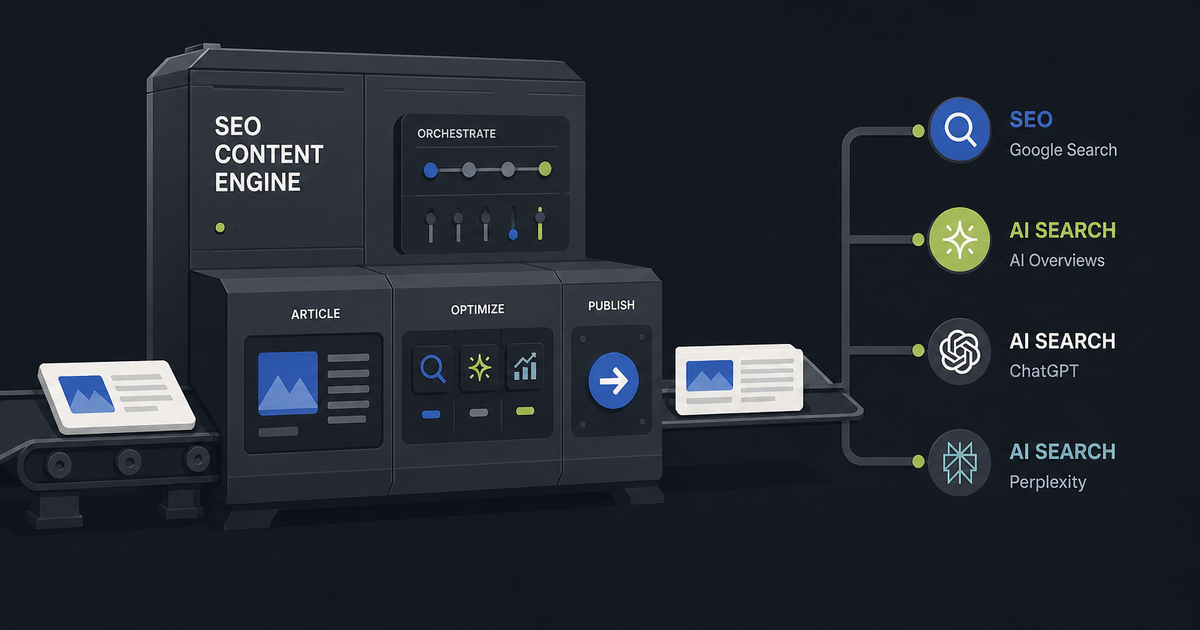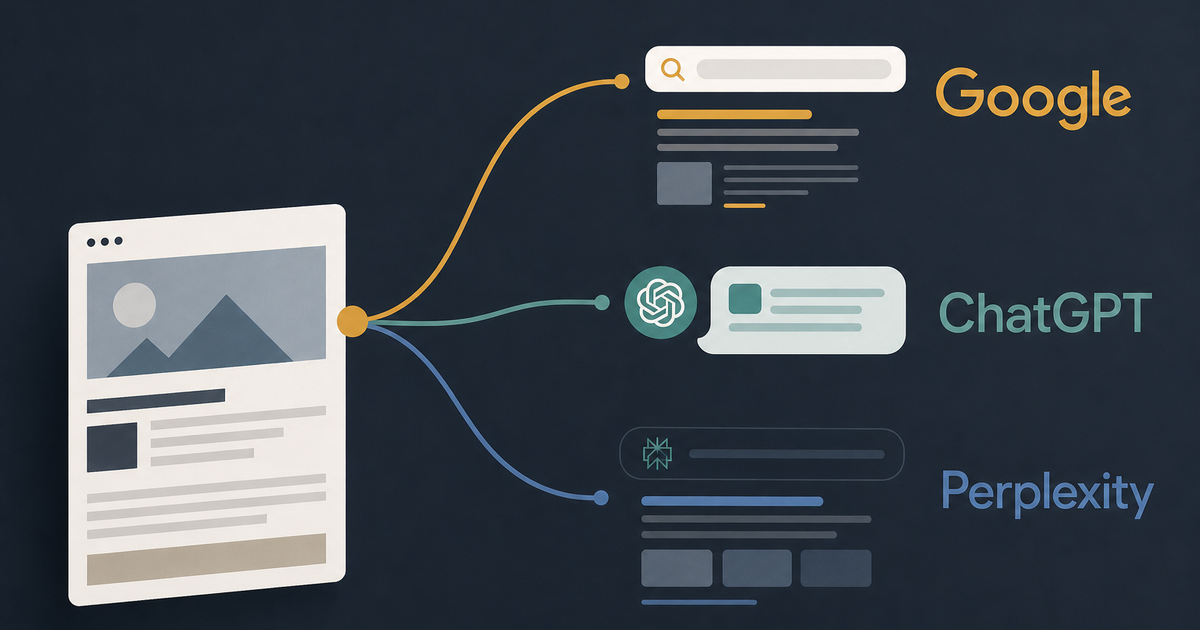
SEO for AI Search: Google, ChatGPT, and Perplexity
As of July 2026, seo for ai search means writing so machines can read, summarise, and cite your page, not just index it. Google AI Overviews, ChatGPT-style answers, and Perplexity each surface information differently, so the same article needs different proof signals on each platform.
For teams using Essel, the brief is no longer “write a good page and hope it ranks.” It is “build a page that can be parsed, reused, and trusted across answer engines.”
Key takeaways
- SEO for AI search now spans Google AI Overviews, ChatGPT, and Perplexity, but Google rewards crawlability and structure while ChatGPT and Perplexity reward quote-ready passages and clearer sourcing.
- AEO and GEO are the umbrella terms people use for answer-engine optimisation and generative engine optimisation.
- Google still depends on crawlability, topical depth, and structured data, while ChatGPT and Perplexity lean harder on concise answers, named entities, and explicit proof.
- The strongest pages lead with direct answers, then back them with original detail, named entities, and evidence a model can cite cleanly.
- SaaS teams win by turning this into a repeatable workflow: audit, rewrite, publish, refresh, and relink.
What changes in SEO for AI search?
SEO for AI search means shaping content so AI systems can extract a clean answer, not just a ranking signal. The practical shift is from optimising for clicks alone to optimising for inclusion in summaries, citations, and answer blocks across Google, ChatGPT, and Perplexity.
That is why people now use terms like AI SEO, AEO, and GEO when they talk about the field. The labels vary, but the job is the same: make the page easy to understand, easy to trust, and easy to reuse.
The change is not one-size-fits-all. Google still behaves like a search engine with layered ranking systems, while ChatGPT and Perplexity behave more like answer systems that prefer compact, reusable passages.
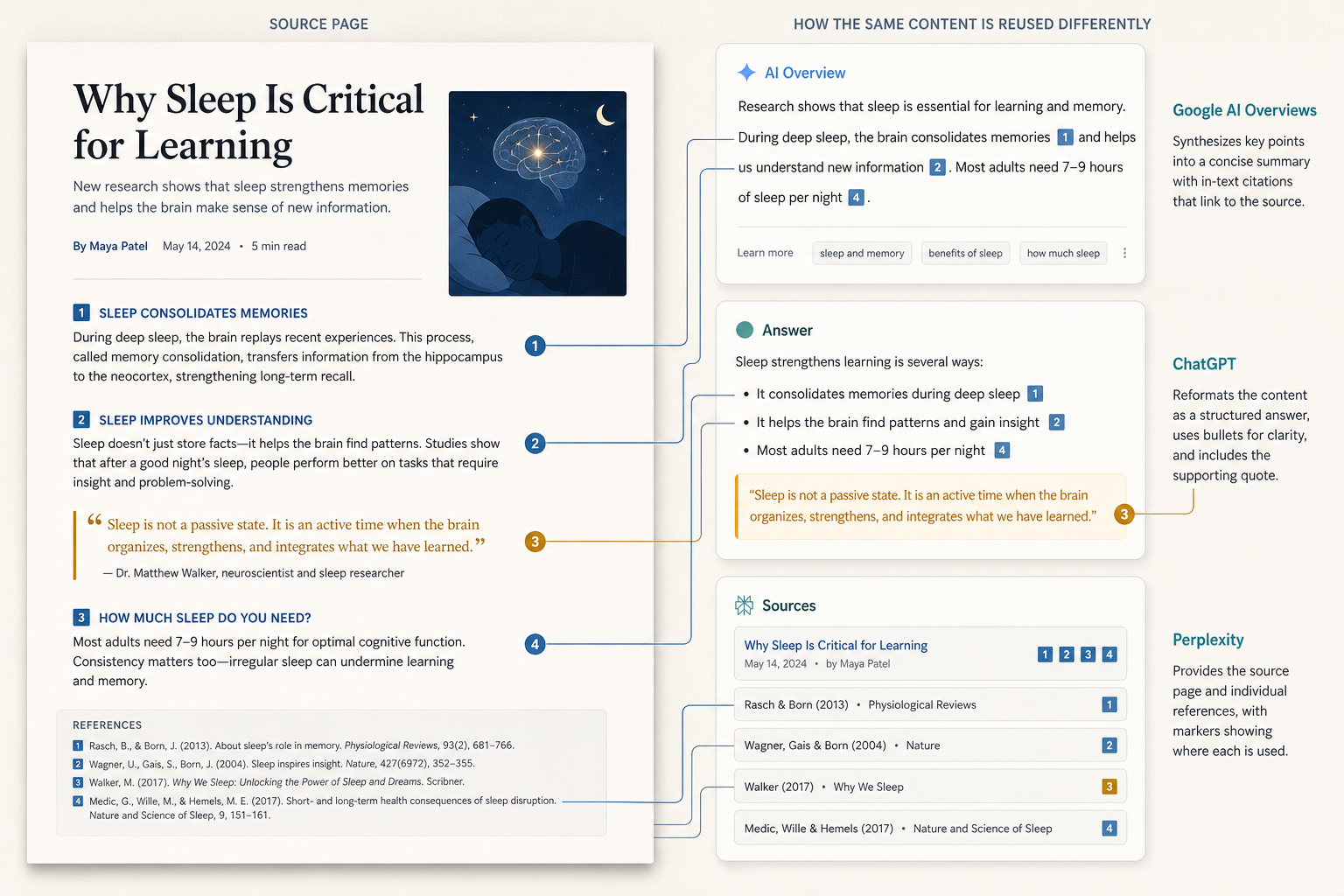
The same page needs different extraction cues on each platform.
How does Google AI Overviews change SEO?
Google AI Overviews make SEO more answer-shaped, but they do not replace the fundamentals. Google still needs crawlable pages, strong topical coverage, and clear site structure, yet the pages most likely to appear in AI Overviews usually give the model a short answer block it can lift without guessing.
In practice, that means cleaner headings, tighter definitions, stronger entity coverage, and structured data all help. Google’s own guidance on succeeding in AI search has stressed helpful, original content and clear page structure, which matches the same direction many SEO teams already see in the SERP.[^1]
For a SaaS blog, the best pattern is usually: state the answer in the first paragraph, back it with a specific example, then use internal links to deepen the topic cluster. That is also where structured data helps, because it gives Google more explicit context about the page.
One useful mental model is this: Google AI Overviews reward pages that can be summarised without losing the point.
Example: A page about pricing software that opens with a 40-word answer, includes a comparison table, and names the pricing factors by entity is easier for Google to reuse than a long intro followed by vague advice.
How does ChatGPT change SEO?
ChatGPT changes SEO by rewarding passages that are easy to chunk, quote, and trust. It does not present a classic list of blue links, so the winning move is to make your content reusable as a source of concise language, not just discoverable as a page.
That is where proprietary expertise matters. If your page only repeats generic marketing language, it gives the model nothing stable to reuse. If it contains a clear method, a named framework, a specific benchmark, or a first-hand observation, it becomes far more citation-worthy.
For ChatGPT, the best on-page structure is usually compact and explicit: a definition, a comparison, a numbered process, or a claim backed by evidence. This is also where what is SEO for AI called becomes a useful internal read, because the terminology around AEO and GEO helps teams align their content model with how answer engines actually work.
ChatGPT also tends to reward pages that use conversational phrasing without becoming vague. The content should sound like a person explaining the answer clearly, not a brand trying to sound clever.
How does Perplexity change SEO?
Perplexity changes SEO by putting citations at the centre of the result. That makes source quality, specificity, and answer-first formatting more important than they often are in traditional search.
If Google can sometimes infer context from a wide page, Perplexity usually wants a cleaner source trail. Pages with named entities, direct statements, and supporting evidence are easier to lift into a response with a visible citation.
This is one reason Search Engine Land has become a useful industry reference point for AI search reporting: it tracks how the rules are evolving while the ecosystem is still moving. For content teams, the lesson is simple. If the page cannot be cited cleanly, it is less likely to travel well through Perplexity.
Perplexity also rewards intent match. If the page answers the exact question with a precise structure, it has a better chance of being included in the synthesis than a broader page that only circles the topic.
Google vs. ChatGPT vs. Perplexity: what actually changes?
The differences are mostly about what each system needs in order to trust and reuse the page. Google still cares most about discoverability and summary inclusion, ChatGPT cares about model-friendly passages, and Perplexity cares about citation-backed answers.
| Criterion | Google AI Overviews | ChatGPT | Perplexity |
|---|---|---|---|
| Primary win | Summary inclusion in search | Reusable, trustworthy passages | Visible citation in an answer |
| Best structure | Strong headings, entity depth, schema | Short answer blocks, concise definitions | Answer-first copy with explicit sourcing |
| Link value | Supports crawlability and context | Indirect, mostly for source grounding | Useful when citations are clear and specific |
| Proof style | E-E-A-T, topical depth, structured data | Proprietary expertise, exact language | Named sources, evidence, specificity |
| Content format | Comprehensive page architecture | Chunkable snippets and examples | Direct answers with sources attached |
The biggest mistake is treating all three like the same surface. A page that is excellent for Google may still be too sprawling for ChatGPT, while a page that feels citation-ready for Perplexity may need more depth and internal linking to compete in Google.
The practical answer is to write one strong page, then tune the surface area. Use clear H2s, keep answer blocks tight, and make sure the page can stand alone even if a model only lifts a few paragraphs.
What should stay the same across all three platforms?
The durable SEO fundamentals do not change just because the interface changes. Topical authority, original expertise, and clean information architecture still matter everywhere.
A page still needs to answer the question early, use precise entities, and avoid filler. It still benefits from internal links, strong on-page SEO, and a structure that helps both crawlers and models understand what the page covers.
That is also where internal linking strategy keeps paying off. Internal links help distribute context across a topic cluster, which matters whether the next reader is a crawler, an answer engine, or a human skimming for the fastest route to the answer.
The same is true for how to do AI SEO. The workflow matters less than the repeatability: identify the gap, draft the answer, add proof, optimise the structure, publish, then refresh it when the evidence changes.
What content structures earn AI citations?
The pages most likely to earn AI citations usually make extraction easy. Short definition blocks, comparison tables, stepwise lists, and evidence-backed claims give models something they can lift without heavy interpretation.
That does not mean every page should become a glossary entry. It means the page should front-load the answer, then support it with examples, statistics, and specific details a model can trust.
Structured data helps here, but it is reinforcement, not a guarantee. So does content scoring, because it gives teams a way to check whether a page actually reads like a citation candidate before they ship it.
Tip: If a paragraph cannot be quoted without losing meaning, it is probably too soft for AI search. Tighten the claim, add an entity, or give it a number.
A useful checklist for citation-ready sections looks like this:
- Lead with the answer in one sentence.
- Use a named entity or framework in the first two lines.
- Add one specific example, benchmark, or source.
- Keep the passage self-contained enough to stand alone.
- Add internal links only where they clarify the topic, not where they distract from the answer.
How can SaaS teams adapt their workflow?
SaaS teams should adapt by treating AI search visibility as a content system, not a one-off optimisation task. The workflow should start with audit, move into rewrite, then continue through publishing and refreshes.
First, review your highest-value pages for direct answers, entity coverage, and citation-ready passages. Then map the gaps around Google AI Overviews, ChatGPT prompts, and Perplexity-style questions, especially where the current page answers the topic but does not answer it cleanly enough.
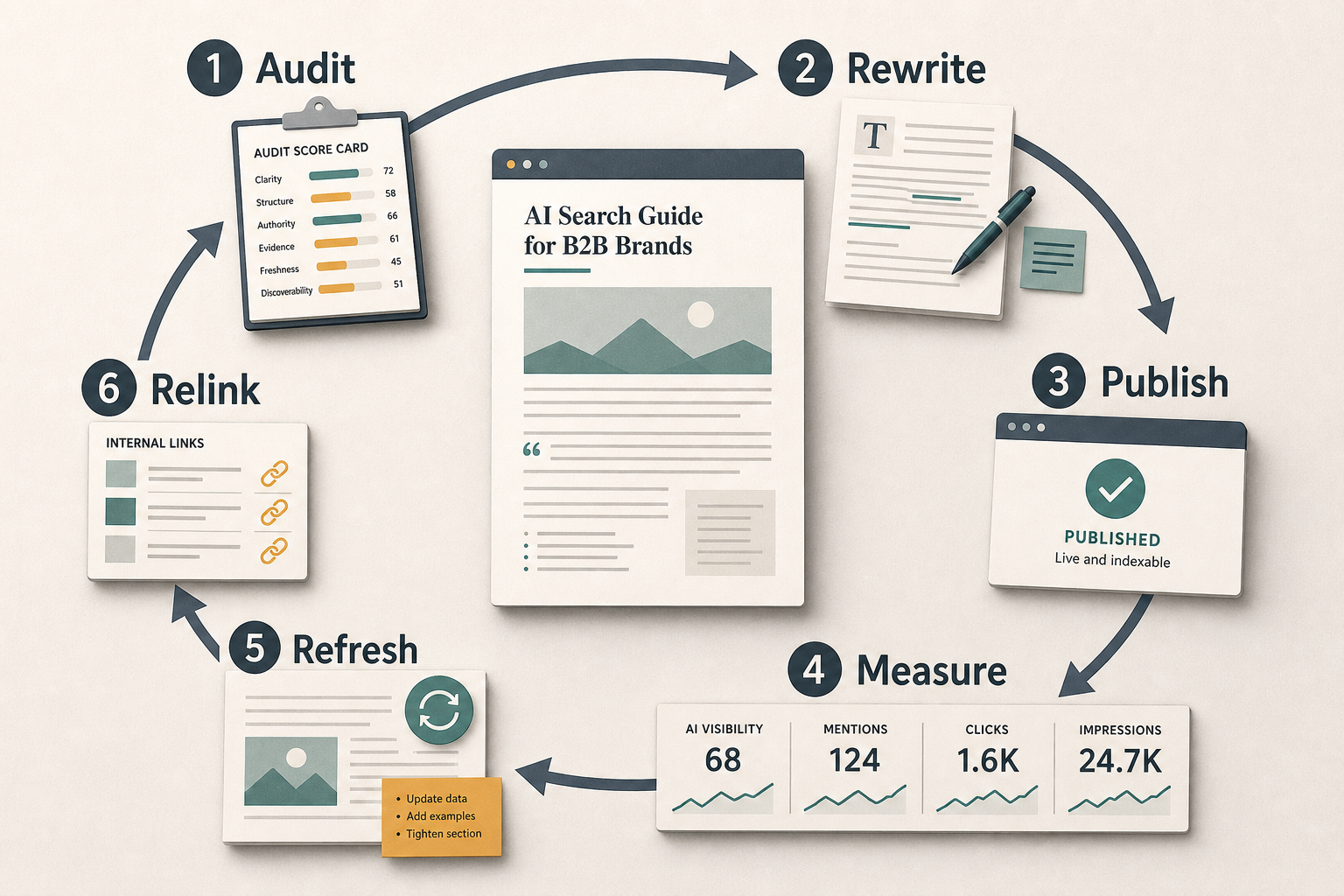
AI search visibility is a continuous loop, not a one-time tweak.
Next, refresh the content cadence. AI search changes quickly, and the pages that stay visible are usually the ones updated with new evidence, clearer structure, and stronger internal links.
If you want to automate that loop, Essel is built for the full workflow: research, drafting, optimisation, publishing, and refreshes. That matters most for small teams that need to ship more often without building a full SEO stack around every article.
A practical rollout plan:
- Audit your top traffic pages.
- Rewrite the answer block first.
- Add supporting entities, proof, and structured data.
- Link the page into its topic cluster.
- Refresh it on a schedule tied to new evidence or ranking movement.
How is AI changing SEO?
AI is changing SEO by shifting more value toward pages that can be interpreted immediately. The page still needs to rank, but now it also needs to be summarised, cited, or synthesised by an AI layer.
That means classic ranking tactics are still necessary, but not sufficient. A page can be technically solid and still underperform in AI search if it buries the answer, uses vague copy, or lacks a clear source trail.
The winning pattern is simple: answer first, prove second, structure third. That works across Google, ChatGPT, and Perplexity because each one rewards clarity even if they weight it differently.
How does AI affect SEO?
AI affects SEO by changing the shape of the result, not just the ranking mechanics. Search is becoming less about ten blue links and more about whether your page can feed an answer engine cleanly.
Traditional signals like crawlability, relevance, and authority still matter. What changes is the format pressure around them: shorter answer blocks, clearer entities, more explicit sourcing, and better page structure.
For teams that publish at scale, the upside is straightforward. If you build for AI search once, the same page can often perform better across organic search, answer engines, and internal content reuse.
How will AI change SEO?
AI will change SEO by making content operations more important than isolated optimisation. The teams that win will not just create more pages, they will create better systems for updating, relinking, and reusing them.
That pushes the field toward AEO and GEO as operational disciplines, not just buzzwords. It also means content scoring, topic gap analysis, and refresh cadences become part of the core SEO stack rather than optional extras.
If the article has one practical takeaway, it is this: build pages that can be cited today and still make sense after the next model update. That is the safest way to keep traffic compounding across Google and AI search.
Frequently asked questions
How is AI changing SEO?
AI is changing SEO by rewarding pages that are easy for answer engines to read, quote, and cite. The strongest pages now combine clear structure, direct answers, and evidence, so they can perform in Google AI Overviews, ChatGPT-style responses, and Perplexity citations.
How does AI affect SEO?
AI affects SEO by raising the value of extractable content and lowering the value of vague filler. Pages still need relevance and authority, but they now also need answer blocks, named entities, and a format that models can summarise without rewriting the whole argument.
How will AI change SEO?
AI will change SEO by turning content operations into a more continuous loop. Teams will need to publish, measure, refresh, and relink more often, because AI search visibility depends on pages staying current, clear, and easy to reuse.
[^1]: Google Search Central, "Succeeding in AI search" https://developers.google.com/search/blog/2025/05/succeeding-in-ai-search