What Is AI SEO? A Practical Guide for 2026
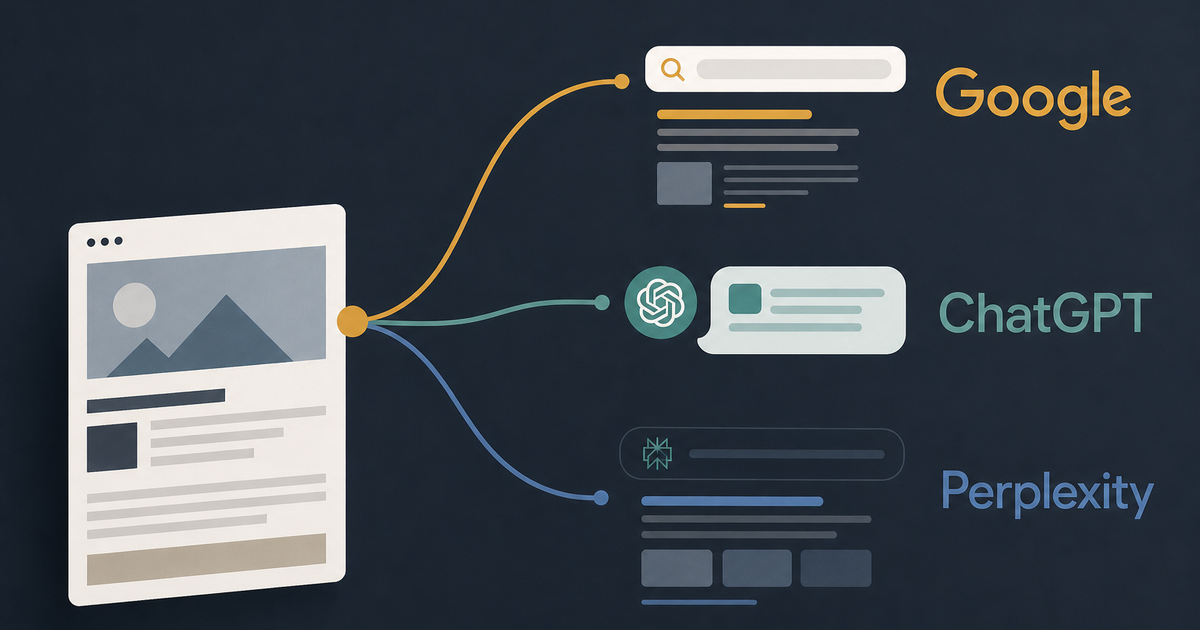
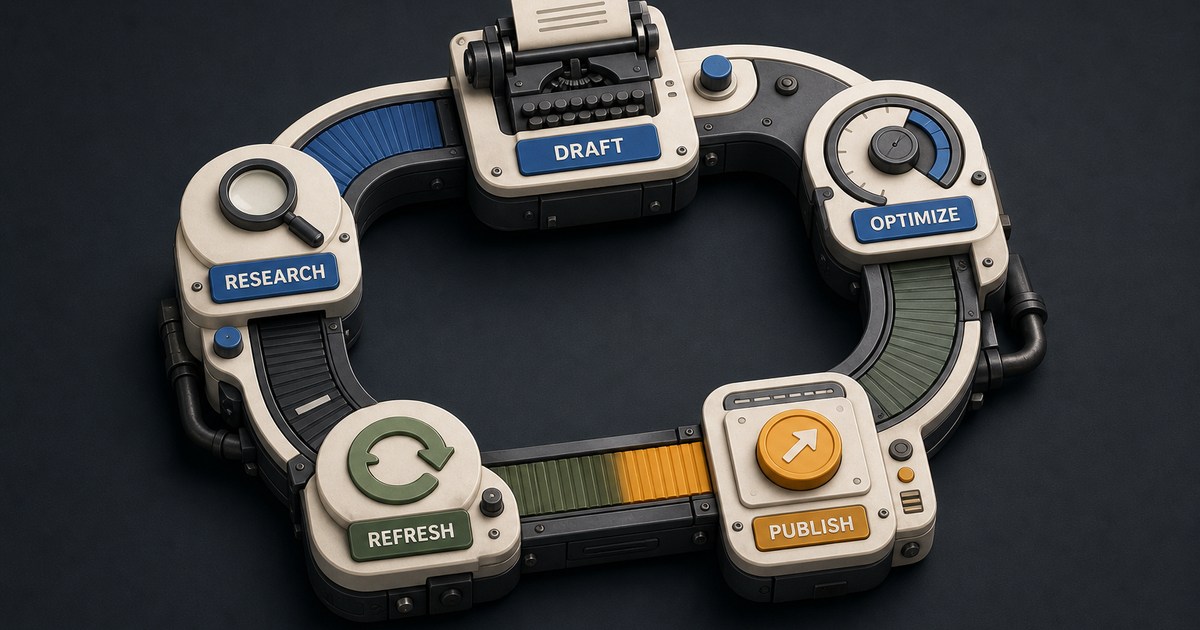
As of June 2026, AI SEO is the operating layer that helps teams earn visibility in Google Search, AI Overviews, ChatGPT, and Perplexity. It turns research, drafting, optimization, publishing, and refreshes into one repeatable system, so content can keep showing up as search becomes more answer-driven. Essel is built for that workflow.
Key takeaways
- AI SEO helps content appear in both ranked results and AI-generated answers.
- The strongest pages are structured, source-backed, and easy for machines to reuse.
- AI SEO matters now because answer surfaces can reduce clicks while increasing the value of citations.
- Teams need a repeatable system, not one-off prompts, to keep pace.
- The best workflows combine human strategy with automation for research, drafting, optimization, and refreshes.
What is AI SEO?
AI SEO is the practice of shaping content and site signals so AI-driven search systems can find it, interpret it, and use it in answers. In plain English, it is SEO for a world where a search result may be a blue link, an AI Overview, or a cited passage inside an assistant response. If a page is easy for humans to read but hard for machines to parse, it leaves reach on the table.
The term covers more than one surface. A page that performs well in Google Search still needs clear structure and trustworthy sourcing to show up in AI Overviews, ChatGPT, and Perplexity. That is why modern teams often run a visibility score across SEO and AI search instead of treating them as separate problems.
It also helps to place the term in product context. Essel uses that same logic to automate research, drafting, optimization, publishing, and refreshes for SEO blogs, which is useful when a team wants more output without assembling a full content stack. For a broader view of the platform, the homepage shows how it fits into modern search visibility.
Why AI SEO matters now
AI SEO matters now because search is changing from a single-results-page model to a mixed system of ranked links, generated summaries, and direct answers. When a query gets resolved inside an AI surface, the page that gets cited or summarized earns disproportionate value. When it is not cited, even a strong ranking can lose clicks.
That shift changes the business math. Organic traffic is still valuable, but the old assumption that “rank = click” is weaker than it was. Teams now need content that can win on both fronts: the classic SERP and the answer engine. In practice, that means stronger topical coverage, cleaner structure, and more explicit entity relationships across the page.
A June 2026 benchmark from Semrush found that AI Overviews appeared in 13.14% of U.S. desktop searches in March 2025, up from 6.49% in January 2025. That kind of growth explains why content teams can no longer treat AI surfaces as a side project. One-off prompts are not enough when the goal is to keep pace with Google, ChatGPT, and Perplexity at once.
It also changes how content teams operate. The teams that keep up use repeatable systems for research, production, and refreshes, because AI search visibility compounds when content stays current and well-organized.
Note: Google’s own documentation still centers on helpful, crawlable content and clear page structure, which is a reminder that AI SEO is not a replacement for SEO fundamentals.
How AI SEO works across Google, ChatGPT, and Perplexity
AI SEO works by making a page easy to crawl, easy to quote, and hard to misread. Google still relies on crawlable pages and relevance signals, while AI systems tend to prefer passages that are concise, well-supported, and semantically clear. The overlap is the real opportunity: a page that works for humans, search engines, and answer engines usually has the same foundation.
There are four practical ingredients. First, topical coverage needs to be broad enough that the page answers the real query, not just the literal keyword. Second, the structure has to be machine-friendly, with headings that map to the user’s questions. Third, the content needs credible entities and sources, so the system can trust and reuse it. Fourth, freshness matters because AI surfaces tend to reward current, stable explanations over stale filler.
A useful test is to read the page like a parser would. Does the headline tell you what the page is about? Do the headings break the topic into reusable chunks? Are the claims anchored to named sources? If not, the page may still rank sometimes, but it is less likely to be surfaced or cited consistently.
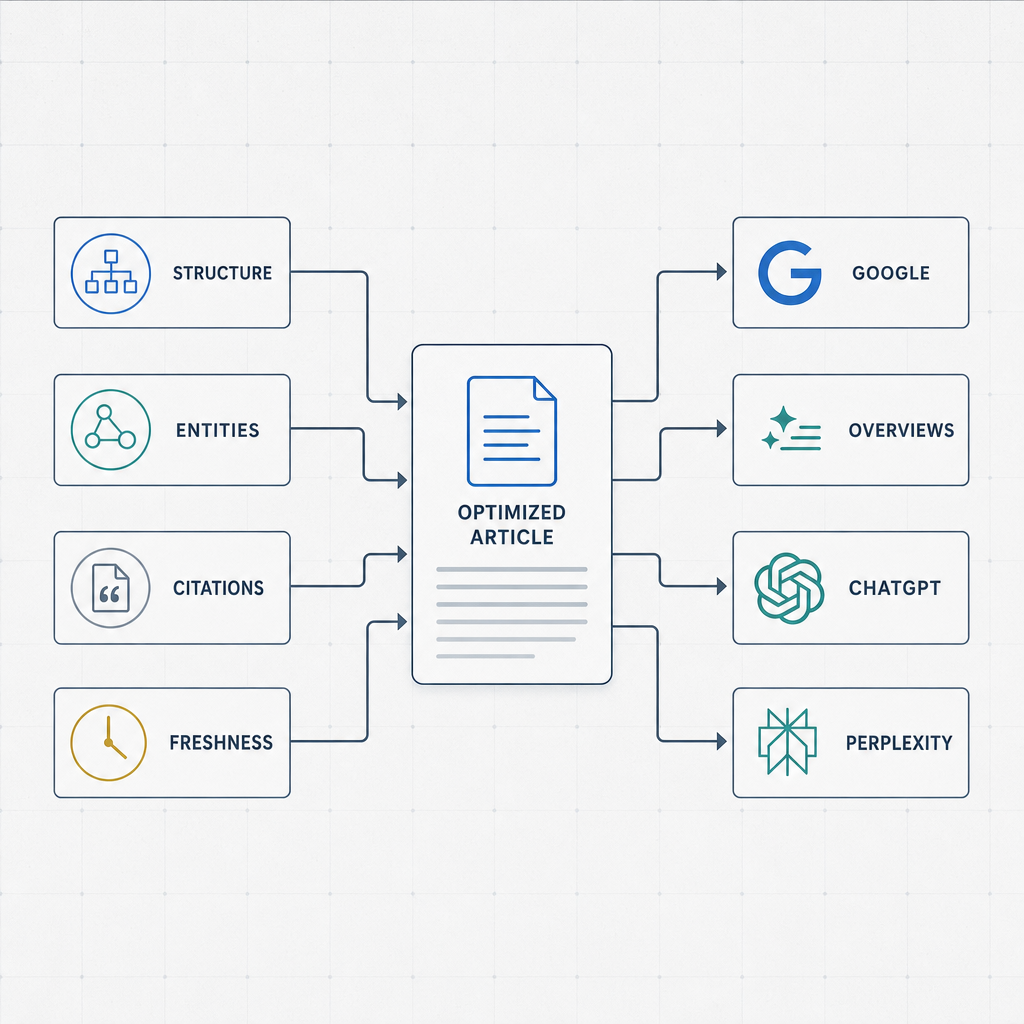
The same page can be optimized for both ranked results and AI-generated answers.
A practical way to inspect this is to compare how a page performs across Google, AI Overviews, and assistants. If you want a quick benchmark, Essel’s free SEO and AI search score is designed to show where structure, metadata, and content signals are helping or hurting visibility.
What is SEO for AI search called?
There is no single universal name yet. People use AI SEO, SEO for AI search, GEO, AEO, and AI search optimization depending on the audience and the surface they mean. The naming is still messy because the market is still moving, and the tools are evolving faster than the labels.
In practice, the differences are mostly about emphasis. AI SEO is the broadest term and usually covers visibility across Google Search and AI answer engines. GEO often points to generative engine optimization, while AEO usually means answer engine optimization. If someone asks “what is SEO for AI called?” or “what is AI SEO called?”, the honest answer is that the industry has not settled on one standard term yet.
That matters because the label can change the workflow. A team optimizing for Google alone may focus on rankings and snippets. A team optimizing for AI search also cares about passage clarity, entity coverage, citations, and whether a system can quote the page without distortion. The work overlaps, but the target surface is wider.
How to use AI for SEO without turning content generic
Use AI to accelerate the workflow, not to replace the strategy. The highest-value use case is not “write me a blog post.” It is research, clustering, outline generation, draft acceleration, on-page optimization, and refreshes at a pace that human-only teams struggle to match.
- Start with research. Use AI to collect topic variants, related entities, and common questions, then validate them against search intent and real SERPs.
- Build a sharp outline. Force the page to answer the main question first, then cover subquestions in a sequence that maps to how readers and machines scan.
- Draft for structure, not volume. Short paragraphs, explicit headings, and concrete examples beat generic filler every time.
- Add sources and entity coverage. Name the frameworks, tools, platforms, and documents that make the page legible to search systems.
- Refresh on a schedule. The best AI SEO workflows revisit content after ranking shifts, new product releases, and search interface changes.
The guardrails are what keep the output useful. Human review should catch factual drift, thin claims, and pages that sound polished but say very little. Structure matters too: if the page’s headings are messy, even good copy can be harder for machines to reuse. That is why tools that check clear content structure can be more valuable than another prompt template.

AI speeds up the process, but editorial review keeps the output useful and distinct.
Example: A SaaS team publishing two posts a week can use AI to cluster keywords, draft first passes, and refresh older posts, while an editor enforces source quality and differentiation. That setup scales content without turning the site into a pile of near-duplicates.
AI SEO tools and services: what to look for
The best AI SEO tools do more than generate text. They help teams research, write, optimize, publish, and refresh content in one system, or at least in a workflow that does not break when traffic starts to scale. A point tool can help with one task, but AI SEO is an operational problem, not just a content problem.
When teams compare tools and services, the real trade-offs are speed, control, and repeatability. In-house workflows give the most control but demand more coordination. AI SEO services reduce the operational load but can become expensive or opaque. Purpose-built tools sit in the middle when they support the full lifecycle instead of only the draft stage.
| Criterion | In-house workflow | AI SEO tool | AI SEO service |
|---|---|---|---|
| Speed | Slower to set up | Fast once configured | Fast to start |
| Control | Highest | Medium | Lower |
| Repeatability | Depends on process | Strong | Varies by provider |
| Refreshes | Manual | Built into workflow | Often included |
| Scale | Limited by headcount | High | Medium to high |
For teams comparing platforms, Essel alternatives is a useful starting point because it frames AI SEO tools and services against the operational need: keep publishing without building a full stack. Meta handling still matters too, which is why meta description optimization remains part of the picture even in AI-first search.
What AI SEO is not
AI SEO is not just using ChatGPT to write blog posts. A prompt alone does not create search visibility, authority, or citations. If the output is generic, unverified, or structurally weak, it usually underperforms in both Google and AI answer engines.
It is also not a shortcut around SEO fundamentals. Pages still need real intent matching, useful coverage, and enough credibility to be reused safely. AI can speed up the work, but it does not replace keyword judgment, editorial standards, or technical hygiene.
The fastest way to get AI SEO wrong is to publish thin content at scale and assume volume will compensate for quality. Modern search surfaces are less forgiving of filler because they have more options and more context. If a system cannot tell why a page deserves to be surfaced, it usually chooses something clearer.
Frequently asked questions
How is AI changing SEO?
AI is changing SEO by expanding visibility from ranked results to generated answers. That means content now competes not only for position on the SERP, but also for citation inside AI Overviews, ChatGPT, and Perplexity. The pages that win are usually the ones with clearer structure, stronger sourcing, and tighter topical coverage.
How to use AI for SEO?
Use AI for research, outlines, drafting, optimization, and refreshes. The workflow works best when a human sets the strategy, then AI speeds up the repetitive parts and helps maintain output quality at scale. The goal is not to automate judgment, but to remove bottlenecks.
How to do AI SEO?
Do AI SEO by combining classic SEO with content built for AI search surfaces. Start with a question-led outline, add entity-rich sections, cite real sources, and keep the page fresh enough to stay useful when answer engines recrawl or re-rank it.
What do you call SEO for AI?
Most teams call it AI SEO, SEO for AI search, GEO, or AEO. The name varies, but the work is the same: make content visible, readable, and reusable across Google and AI-driven answer surfaces.