How to Do AI SEO for Small SaaS Teams
Last updated: 2026-07-12
As of July 2026, small SaaS teams do AI SEO by using AI to compress research, briefing, drafting, optimisation, and refresh work while humans keep editorial control. The goal is simple: ship useful pages faster, cover the right entities, and stay visible in Google, AI Overviews, ChatGPT, and Perplexity. Essel is built to run that workflow end to end, but the method matters even if you use a different stack.
Key takeaways
- A small SaaS team can do AI SEO by running one repeatable loop: research, brief, draft, optimise, publish, and refresh.
- AI should accelerate content ops, not replace subject-matter judgment, product accuracy, or compliance checks.
- The highest-leverage inputs are content briefs, internal linking targets, structured data, and E-E-A-T proof.
- AI search visibility now matters alongside classic rankings, so pages need to read well for humans and machines.
- The fastest way to win is to build a cadence, then improve it with performance data instead of chasing one-off content ideas.
What AI SEO looks like for a small SaaS team
AI SEO for a small SaaS team is a production system, not a prompt trick. It means using AI to speed up the boring parts of SEO work while humans keep the parts that require judgment: positioning, claims, product nuance, and editorial taste. If you want the primer first, this definition of AI SEO is the right place to start.
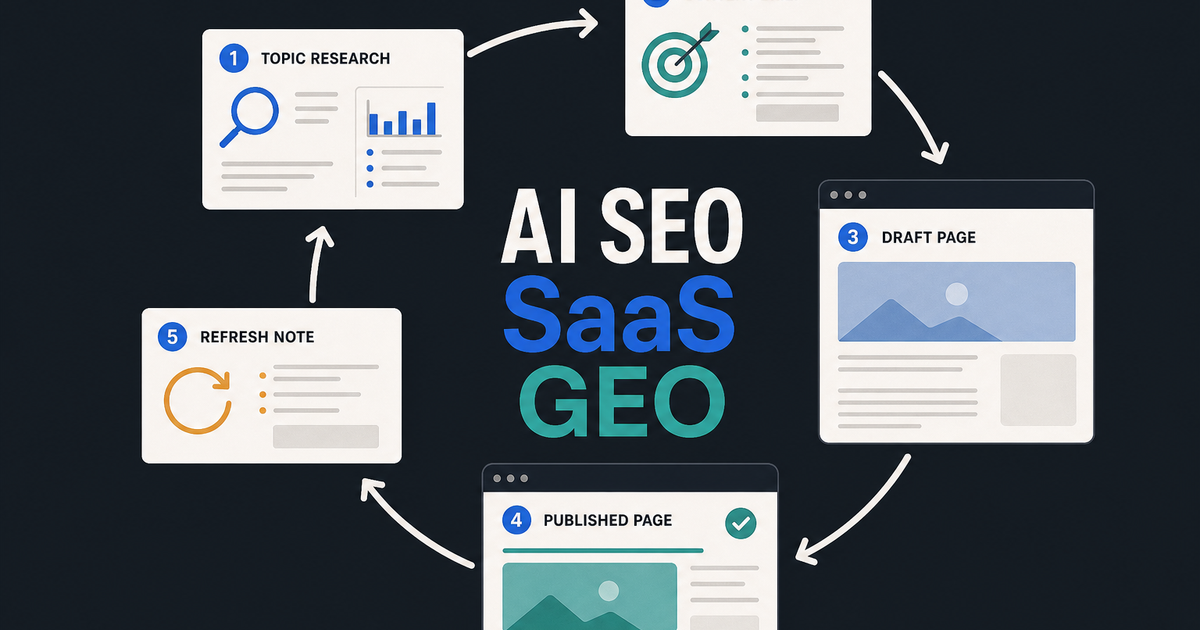
The practical version is a loop. You find topics, build a focused brief, draft quickly, optimise the page for search and AI visibility, publish it, then refresh it when performance changes. That is the core answer to how to do ai seo without turning your content process into chaos.
For small SaaS teams, the winning frame is not “Can AI write everything?” It is “Can AI help us publish consistently enough to compound organic traffic?” In most teams, the answer is yes, as long as the workflow has guardrails.
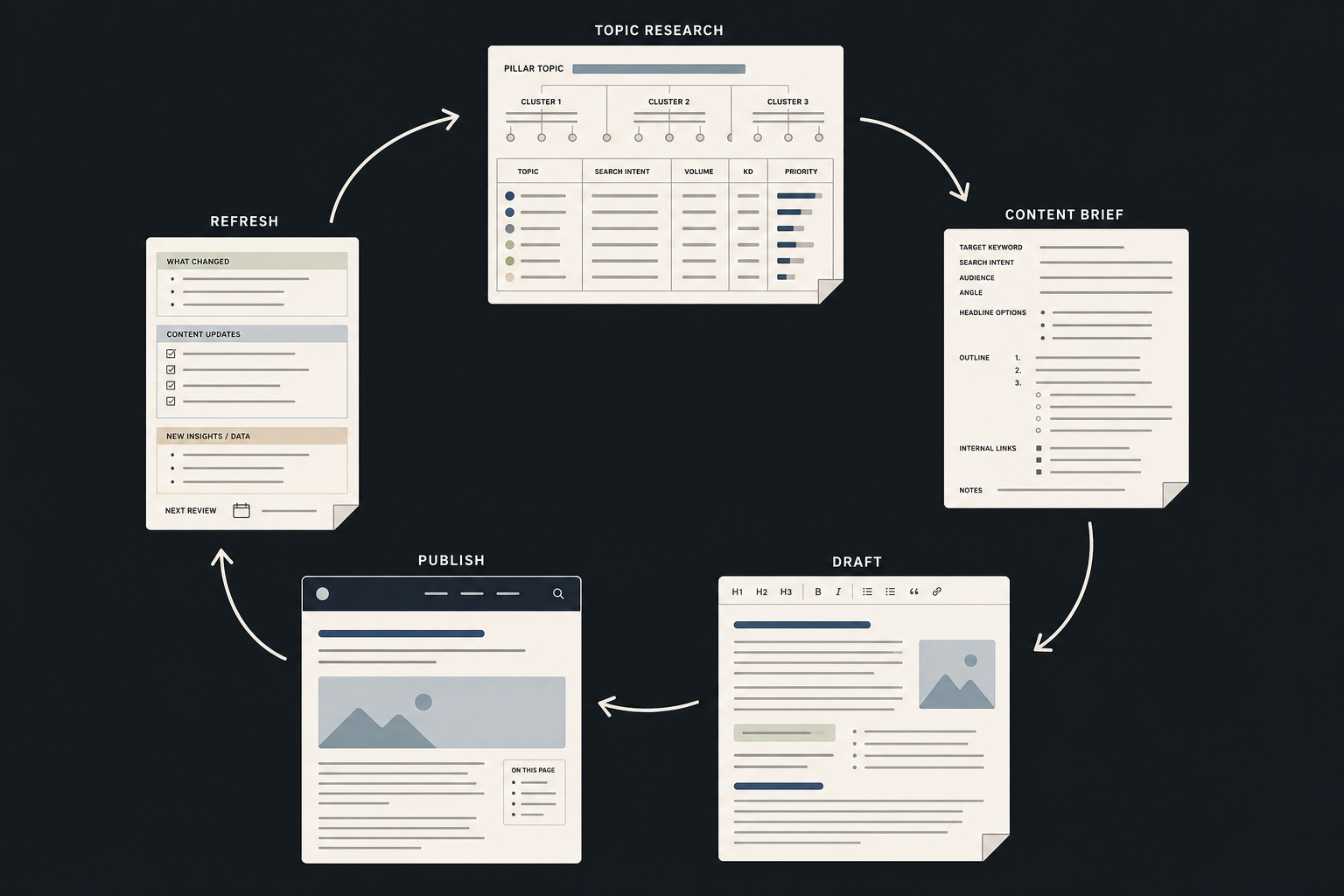
The loop makes the operating system clear: every refresh starts the next round of research.
Set up the inputs before you write
A lean team should lock the inputs before anyone asks AI to draft a page. The minimum set is a topic map, a target persona, a conversion goal, and a short list of pages that deserve internal links. Without those, AI produces output, but not strategy.
Start with one topic cluster per product problem. For example, a SaaS analytics tool might map content around attribution, reporting, and team visibility, then tie each cluster to a demo, trial, or signup page. That keeps the content brief tied to revenue instead of drifting into generic educational content.
Build the brief from signals, not vibes. Seed keywords, question variants, SERP themes, and competitor gaps should all sit in the same document. A strong brief also names the required entities, the angle, the source requirements, and the internal link targets before the draft begins.
Do not skip brand guardrails. If the team does not document tone, approved claims, product boundaries, and E-E-A-T proof points up front, AI will fill the gap with plausible but useless copy. That is how small teams end up revising the same article three times.
Tip: A one-page brief is usually enough for a small SaaS team if it includes search intent, the target reader, must-include entities, one primary CTA, and three internal links.
How to use AI for SEO research and briefs
AI is best used as a research multiplier. It can cluster keywords, summarise SERP patterns, extract recurring questions, and surface topical gaps much faster than a manual pass. Google’s own guidance has long emphasised that helpful content should be written for people first, which is why the research step still needs a human filter.
In a 2024 Ahrefs study of 1,400 pages, pages with more comprehensive topical coverage tended to earn more organic traffic than thinner pages. That kind of signal is why a small team should use AI to widen coverage, then edit the brief so it stays specific to the product and the search intent.
Use AI to answer five questions before you draft: what is the search intent, what entities do the top results cover, what questions are repeated, what evidence would make the page trustworthy, and where should the page link next. That is the difference between a content brief and a content guess.
This is also where a small team can cheaply separate body content from support content. Questions like what is AI SEO or how to use AI for SEO may deserve their own pages or sections, while others belong in FAQ-style support material. The point is to map the query to the right asset instead of stuffing every question into one article.
Use the brief to force precision. If the article is about AI SEO for SaaS, the brief should say whether the page is meant to attract top-of-funnel readers, compare tools, or push product adoption. That choice changes the examples, the CTA, and the type of evidence you need.
How is AI SEO done?
AI SEO is done by following a repeatable loop: research, brief, draft, optimise, publish, and refresh. Small teams do not need a giant stack to execute it, but they do need discipline around each step.
First, let AI help with research and outline generation. Then have a human edit for accuracy, product specificity, and topic fit. After that, add the on-page layer: headings, metadata, internal links, schema, and concise section openers that can be quoted by both search engines and AI answer systems.
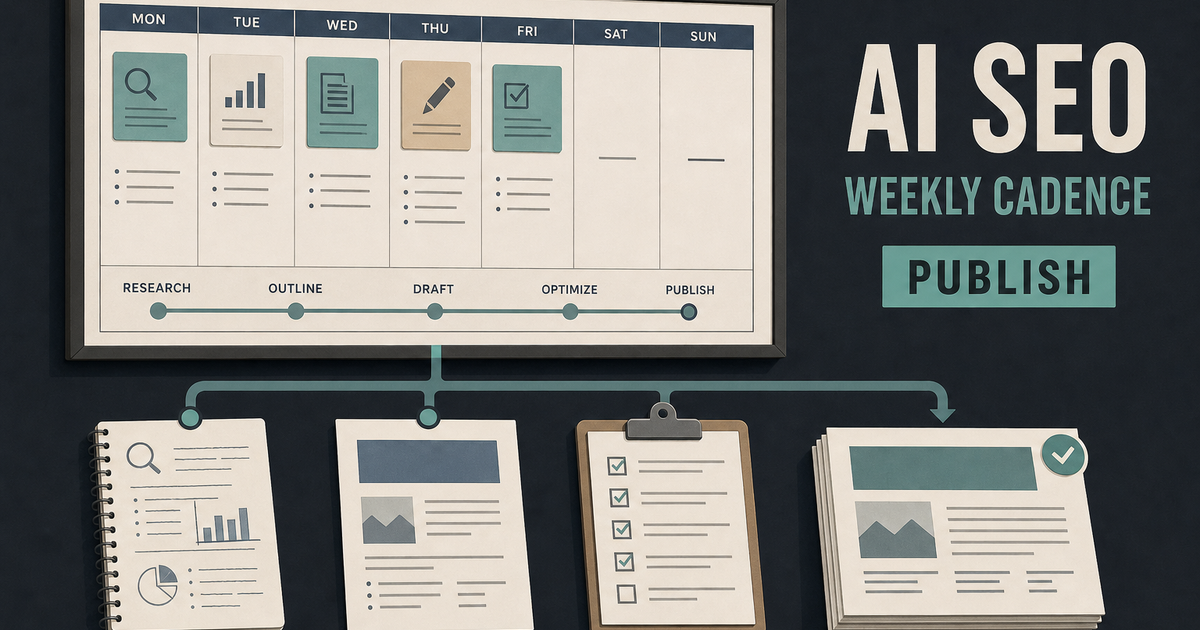
Third, publish on a cadence instead of waiting for perfect conditions. A team that ships two solid pages every week will usually outperform a team that publishes six pages in a burst and then disappears for a month. If you want a repeatable rhythm, this weekly AI SEO cadence is a good operating model.
Finally, refresh pages based on data. If rankings stall, search intent shifts, or product messaging changes, the article should be updated before it goes stale. This is where automation saves time, because the same system can queue refreshes, surface decay, and update internal links without manual spreadsheet work.
Can I use AI to do my SEO?
Yes, but only if AI handles execution and humans handle judgment. For a small SaaS team, AI can cover research, outline generation, first drafts, title ideas, content scoring, and routine audits. It should not own final approval on product claims, compliance language, or anything that requires first-hand company knowledge.
That boundary matters because AI is strongest at throughput, not truth. It can summarise patterns across the SERP, but it cannot know which claim your legal team will reject or which feature is actually live in the product.
The most useful setup is a hybrid one. Let AI do the repetitive work, then let a marketer, founder, or product specialist verify the parts that affect trust. That gives small teams the speed of automation without the risk of publishing generic or inaccurate content.
The strongest use case is not replacing an SEO hire one-for-one. It is replacing the friction of a full content stack, where research lives in one tool, briefs live in another, drafting happens elsewhere, and publishing still needs manual handoffs.
What to optimize on-page for AI search
To win AI search visibility, pages need to be easy to understand, easy to quote, and easy to connect. That means clear headings, concise definitions, entity coverage, and supporting links that show topical depth. It also means writing with an eye toward Google AI Overviews, AEO, and GEO rather than only classic blue-link rankings.
Internal linking is one of the highest-leverage changes for a small team. A well-linked article helps search engines understand the topic cluster and helps readers move from explanation to product page. If you need help operationalising that step, the Anchor Text Suggester can speed up link placement decisions.
Structured data matters when it fits the page type. Use it to clarify what the page is, who wrote it, and how the content should be interpreted. For example, a how-to article, FAQ, or product page can all benefit from markup that reduces ambiguity for machines.
E-E-A-T still matters because AI systems lean heavily on signals of expertise and trust. Concrete examples, specific workflows, named sources, and proof from real product work all make the page more credible than broad, recycled advice.
When the goal is AI search visibility, the page should answer the question quickly, then deepen the answer with evidence. That is why what SEO for AI is called often comes down to GEO, AEO, and related answer-engine terminology, not just traditional SEO language.
How to publish and refresh content with a lean team
A small team should treat publishing as an operating cadence, not a one-off event. The easiest way to keep AI SEO compounding is to build a repeatable queue for briefs, drafts, approvals, CMS publishing, and refreshes. Once the system exists, volume becomes easier to sustain.
Publish by priority, not by inspiration. The pages closest to revenue or the strongest topical gaps should go first. If a post can rank, support a product page, and feed internal links, it should beat a low-stakes thought-leadership piece every time.
Refresh content on triggers. Those triggers include ranking drops, product changes, new feature launches, search intent shifts, and new AI search behaviour. Waiting until traffic collapses is too late for a small team that needs compounding gains.
Track what matters. Rankings alone are not enough. Watch impressions, clicks, citations, assisted conversions, and the amount of time your team spends on production versus optimisation. If the workflow is healthy, the team should spend less time recreating content structure and more time improving what already exists.
What AI SEO tools matter for small SaaS teams?
A small team needs tools that connect research to briefs, drafts to optimisation, and publishing to refreshes. Anything that solves only one part of the workflow usually creates a new bottleneck somewhere else.
The useful categories are clear: topic research, content briefs, drafting, on-page optimisation, internal linking, CMS publishing, and performance tracking. If a tool cannot help you ship and improve content faster, it is probably a nice-to-have rather than a core system.
Free AI SEO tools can be helpful for isolated tasks, especially when you are testing a workflow. But free tools usually break when you need continuity across the full loop. If you want a deeper look at those limits, this breakdown of free AI SEO tools is worth a read.
The buying question is simple: does the tool reduce manual handoffs? If it does not help with briefs, publishing, internal linking, or AI search visibility, it will not change the operating cost of your content program very much. For a practical evaluation process, this AI SEO tools checklist will save time.
How to know if your AI SEO is working
AI SEO is working when the workflow produces more useful pages with less manual friction and those pages start earning visibility. That means looking at rankings, impressions, organic clicks, conversions, and assisted pipeline, not just how many articles went live.
The second signal is AI surface area. If pages begin appearing in AI summaries, answer engines, or cited snippets, the content is doing more than ranking in one SERP shape. That is especially relevant now that Google AI Overviews and other answer experiences can change how discovery happens.
The third signal is operational. A small team should spend less time on repetitive production as the system matures. If every article still requires a fresh scramble for research, structure, links, and publishing, the process is not automated enough.
Use the data to decide what happens next. Expand topics that attract citations and conversions. Refresh pages that show decay. Retire briefs that never performed. That is how a lean team turns AI SEO from a content task into a compounding system.
For teams ready to turn the workflow on, Essel pricing is the natural next step once the process is clear.