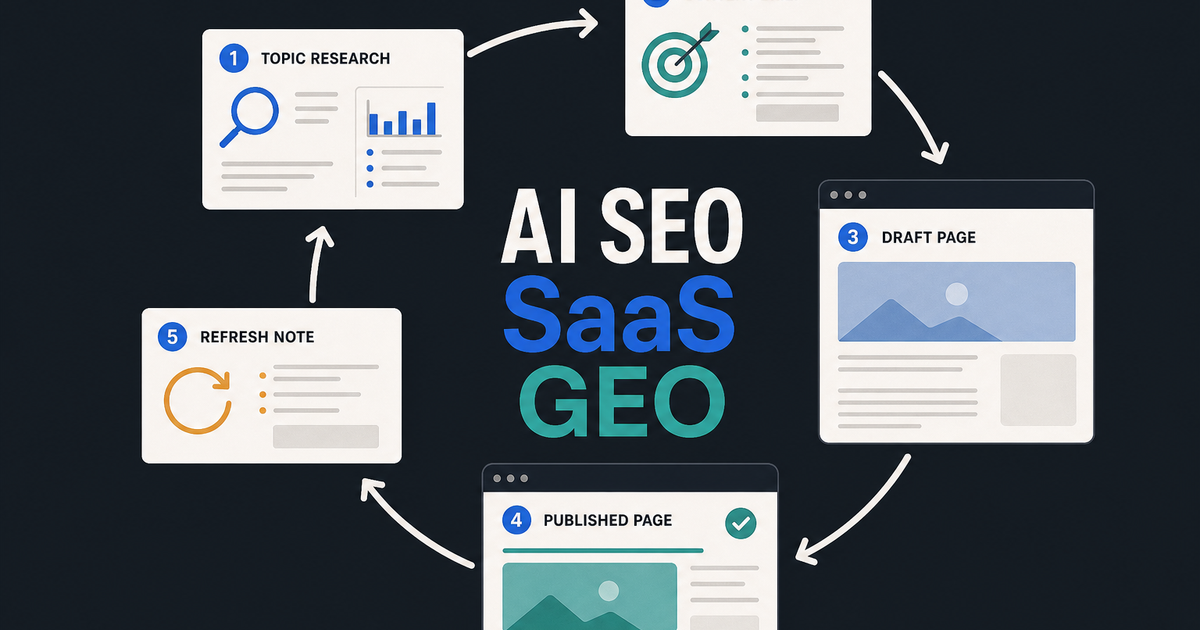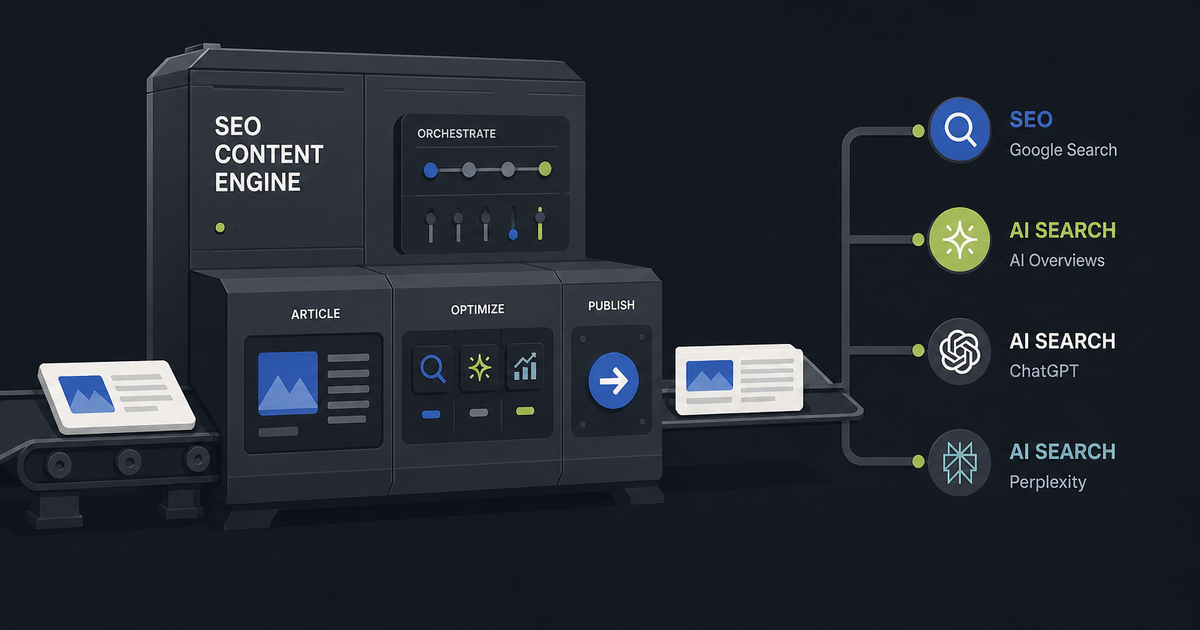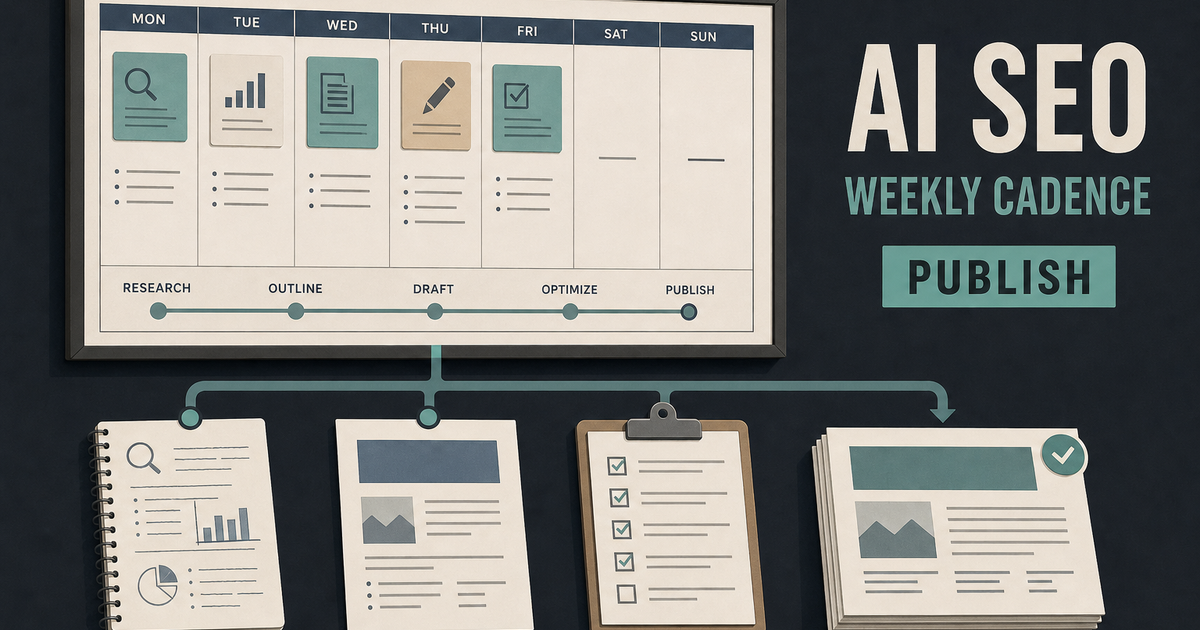
ai seo cadence: a weekly publishing workflow
An ai seo cadence gives teams one repeatable weekly loop for research, drafting, optimization, publishing, and refreshes. As of July 2026, that loop matters for both Google and AI search surfaces, including ChatGPT and AI Overviews, because consistency is what compounds visibility. Essel helps teams run that loop on autopilot, but the cadence itself should stay simple enough to execute every week.
Key takeaways
- A weekly cadence works best when every post has a clear owner, a fixed input set, and a defined publish window.
- The strongest planning inputs are an SEO content calendar, topical clusters, and Search Console gaps.
- AI should speed up research, outlines, optimization, and refreshes, while humans protect accuracy, brand fit, and E-E-A-T.
- The right publishing volume depends on team capacity, not an arbitrary content quota.
- Measurement closes the loop, because the next week’s plan should come from what actually earned clicks, impressions, and rankings.
What an AI SEO cadence looks like in a week
An AI SEO cadence is a weekly operating system for content teams: one plan, one production cycle, one publish window, and one refresh review. The point is not to publish randomly faster. The point is to create a steady rhythm where each piece supports topical coverage, internal linking, and modern search visibility across Google and AI answers. If you want a broader foundation first, what AI SEO is is the right companion read.
In practice, the loop should include four fixed outputs every week: topics selected, drafts produced, content optimized, and live URLs reviewed. That structure keeps the team from re-inventing process each Monday. It also makes it easier to tell whether the system is working, because you can compare output volume with actual search gains.
The cadence should not be treated as a blog-only habit. It should cover the whole path from planning to publishing to refreshes, with Google Search Console, ChatGPT visibility, and AI Overviews in the measurement mix. That is what turns a weekly publishing habit into a compounding SEO system.
Set the weekly inputs: topics, clusters, and calendar
A repeatable week starts with a small, disciplined input set, and the SEO content calendar should be the first filter. Use it to decide which topics are new, which are refreshes, and which are support pieces for a bigger cluster. Then pull Search Console data to find pages with impressions but weak clicks, or topics with no coverage at all.
- Pull the top priority cluster for the week.
Choose one business theme, not five. For example, a SaaS team might focus on onboarding, reporting, or integrations, then map one primary article and two support pieces to that cluster.
- Check Search Console for gaps.
Look for pages that rank on page two, queries with high impressions and low CTR, or sections that deserve an update. Those are usually faster wins than starting from zero.
- Pick one clear publishing objective.
Decide whether the week is for net-new content, a refresh, or internal-link support. Mixing all three without a plan usually creates bottlenecks.
- Lock the calendar before production starts.
A weekly cadence fails when topic selection drifts during drafting. The team needs a stable list before the first brief goes out.
- Keep the queue small enough to finish.
The best cadence is the one the team can actually sustain. A tight calendar beats an ambitious backlog that never ships.
A strong weekly plan also leans on AI SEO workflow basics so research, drafting, and optimization all point at the same target. For lean teams, that discipline matters even more than raw volume.
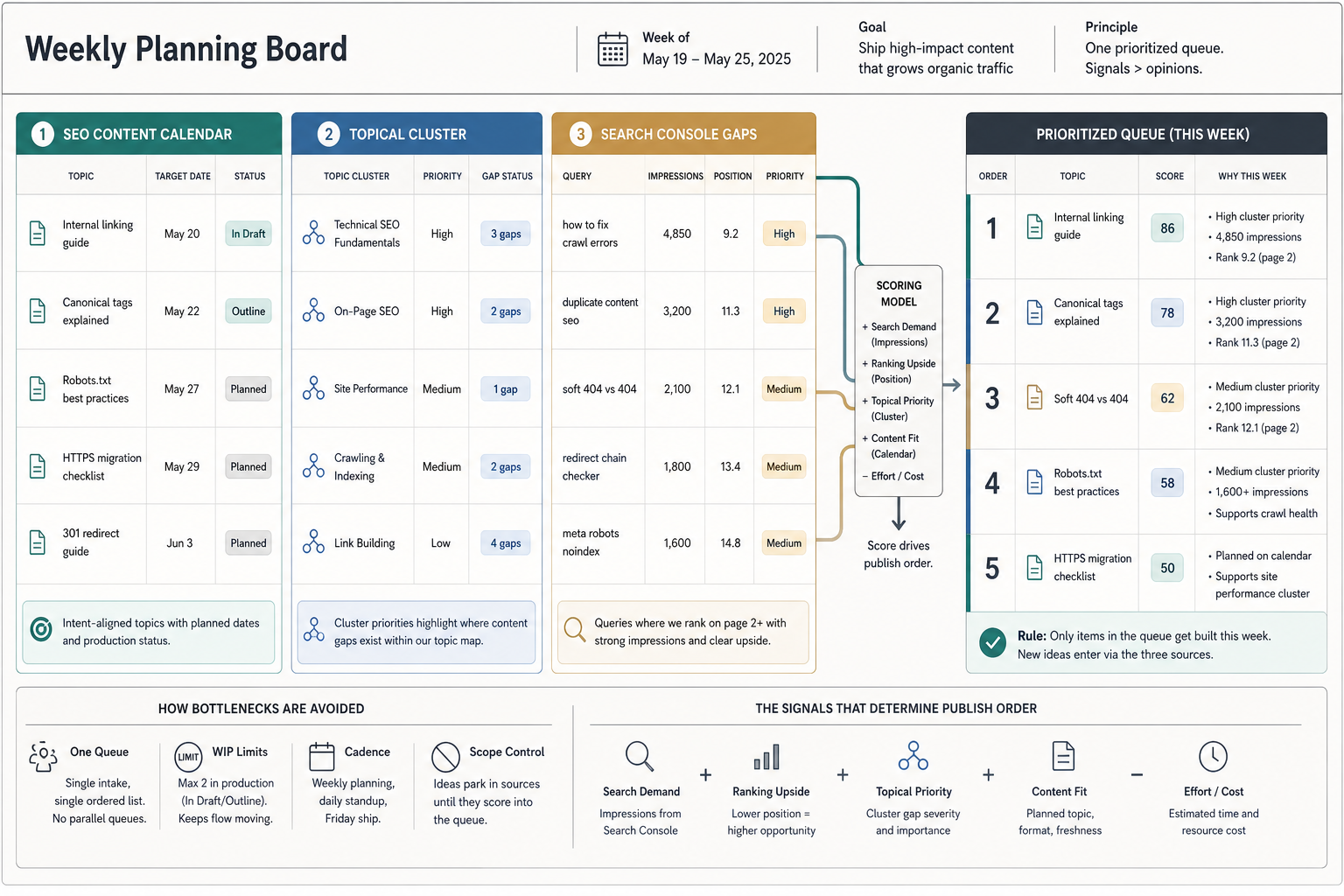
Use one queue to keep topic selection, cluster work, and fixes moving together.
Tip: Keep one live planning board for the week and remove anything that does not map to a publishable URL. If a topic cannot be briefed in ten minutes, it is probably too vague for the current cadence.
Build the production workflow from brief to draft to publish
The production loop should move in a fixed order: brief, outline, draft, optimize, approve, publish, and distribute. That order reduces handoff friction and makes the weekly rhythm visible to everyone involved. It also keeps AI in the parts of the workflow where speed matters most.
- Write the brief first.
Define the target query, audience, angle, internal-link targets, and success metric. A good brief prevents the draft from drifting into generic advice.
- Generate an outline from the brief.
Use AI to expand structure, but keep the topic boundaries tight. The outline should already know the job the article has to do.
- Draft with AI, then edit for intent.
Let AI handle the first pass on research synthesis and section scaffolding. Human review should then tighten accuracy, voice, and usefulness.
- Run on-page checks before approval.
Confirm the title, headings, internal links, entity coverage, and metadata. This is where content scoring helps the team spot missing pieces before publish time.
- Publish in the CMS as part of the cadence.
CMS publishing should not sit outside the workflow. The post is not done until it is live, formatted, and linked from the right pages.
- Ship distribution and internal links together.
A new post should immediately support existing cluster pages, and those pages should point back to the new URL. That loop strengthens crawl paths and topical depth.
If the team wants a tighter checklist for this stage, tooling and checkpoints should be part of the operating review. The question is not whether AI can draft quickly. The question is whether the workflow still protects quality when speed increases.
Use AI checkpoints to improve quality without slowing cadence
AI helps most when it removes low-value work from the week, not when it takes over judgment. The best use cases are research synthesis, outline generation, optimization suggestions, and refresh recommendations. Human editors should keep the final say on brand fit, claims, and whether the piece truly answers the search intent.
A simple quality gate keeps the cadence moving without turning every article into a review marathon. Before publish, check four things: does the piece match the query, does it cover the right entities, does it link to the right pages, and does it read cleanly? That is enough to catch most failures before they hit the CMS.
E-E-A-T still matters inside an AI-heavy workflow. If a section makes a claim, it should either be grounded in a source, tied to a first-party example, or rewritten until it is precise enough to trust. AI can suggest structure, but it should not be allowed to blur evidence.
The same rule applies to refreshes. AI can flag underperforming sections, missing subtopics, or stale examples. Humans should decide whether the fix is a title change, a section rewrite, a stronger internal link, or a full update. That is how the cadence stays fast without becoming sloppy.
How to schedule 1, 2, or 3+ posts per week
The right publishing volume depends on team capacity, editing bandwidth, and how much optimization each article needs. One post per week is enough for many small teams if the post is strong, internally linked, and refreshed on time. Two or three posts per week works when the team has a stable brief-to-publish system and a clear approval chain.
| Weekly volume | Best fit | Main risk | What to protect |
|---|---|---|---|
| 1 post | Solo founders, lean teams | Slow topic coverage | Refresh loop and internal links |
| 2 posts | Small SaaS or content teams | Bottlenecks in review | Brief quality and CMS speed |
| 3+ posts | Mature content ops | Quality drops under pressure | Content scoring and approvals |
The practical rule is simple: increase volume only when the workflow can absorb it. If the team is still fighting over briefs or spending too long on editing, more posts just create more unfinished work. For lean execution patterns, best AI SEO tools for lean teams is the right operational reference.
A healthy weekly content cadence is not measured by ambition. It is measured by repeatability. If the same team can ship the same standard next week without a scramble, the cadence is working.
When the stack starts to strain, lightweight workflows tend to break in predictable ways: briefs go missing, links get skipped, and refreshes never happen. That is usually the point where workflow breaks becomes a real business problem, not just an operational annoyance.
Measure the cadence and refresh what is underperforming
A weekly cadence only compounds if measurement feeds the next cycle. Track the basics every week: published URLs, impressions, clicks, rankings, indexed pages, and assisted conversions. That gives the team a grounded view of what the workflow actually produced.
Google Search Console should be the first review layer because it shows which URLs earned visibility and which ones stalled. Use it to spot pages that need a stronger title, a better intro, more internal links, or a section refresh. Those fixes are usually faster than writing a new post from scratch.
The measurement loop should also include AI search visibility. As more users ask ChatGPT-style interfaces for answers, teams need to know whether their content is being surfaced, cited, or skipped. That is where SEO for AI visibility becomes part of the reporting model, not a side topic.
Refreshes should run on a recurring cadence, not only when traffic drops hard. A page that keeps its structure current, its examples fresh, and its internal links clean is more likely to keep earning. That is how the weekly cadence stops being a content treadmill and starts behaving like a compounding asset.
Warning: Do not confuse more publishing with better SEO. If the weekly loop ignores internal linking, refreshes, or Search Console feedback, the team will produce more URLs without building more authority.
The practical finish line is simple. A good AI SEO cadence gives the team a stable weekly rhythm, clear outputs, and a visible path from topic selection to search growth. Once the loop is in place, each week becomes easier to run than the last.