AI SEO Services vs Agency: What Delivers Results
A SaaS team choosing between ai seo services and an agency is usually choosing between a repeatable content engine and a higher-touch service layer. As of July 2026, the better fit is usually the model that can keep research, drafting, optimization, publishing, and refreshes moving without extra coordination.
Key takeaways
- AI SEO services tend to win when the buyer needs a system that can research, write, optimize, publish, and refresh content continuously.
- AI SEO agencies still make sense for complex launches, enterprise coordination, and one-off strategic work.
- Buyers should compare workflow depth, AEO and GEO coverage, proof of results, and how much manual management the model requires.
- For SaaS and content-led teams, the best outcome is usually an engine that compounds, not a service that depends on project cycles.
What actually delivers: AI SEO services or an agency?
AI SEO services deliver best when the main job is sustained output plus measurable search visibility, while an agency delivers best when the work needs high-touch strategy and custom coordination. That is the cleanest way to separate the two models before the pitch language gets in the way. If you need a quick definition first, see what AI SEO means, then come back to the buying decision.
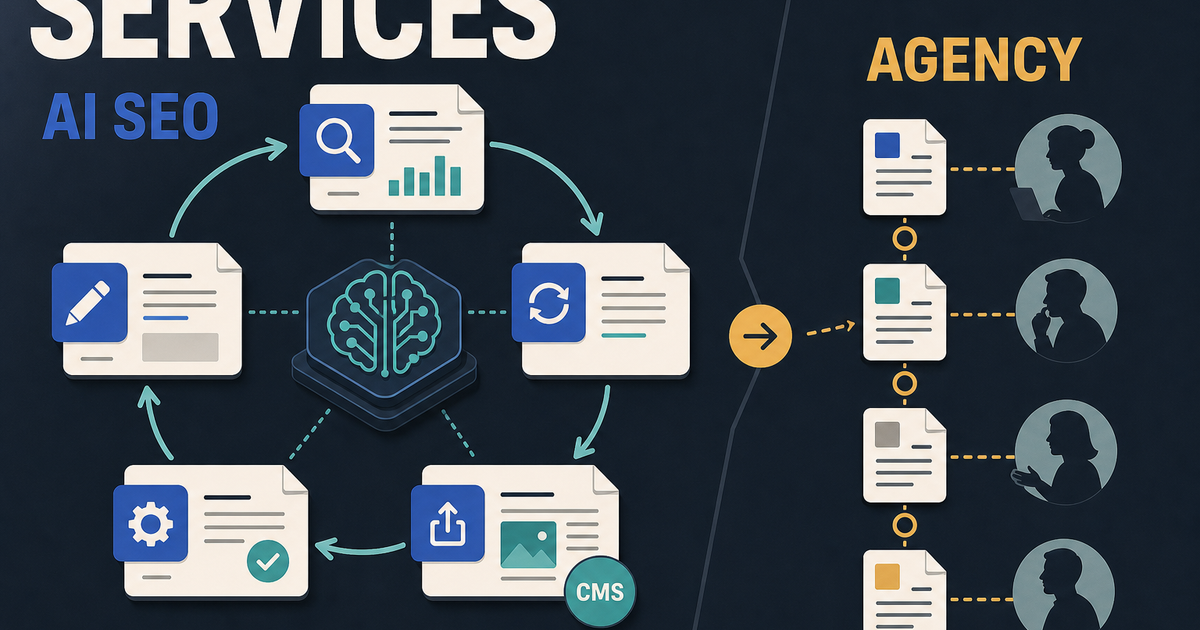
In buyer language, software-led AI SEO services automate the workflow: research, drafting, on-page optimization, publishing, refreshes, and reporting. Human-led AI SEO agencies sell a service layer around strategy, production, and management. Both can use AI, but they do not deliver the same way.
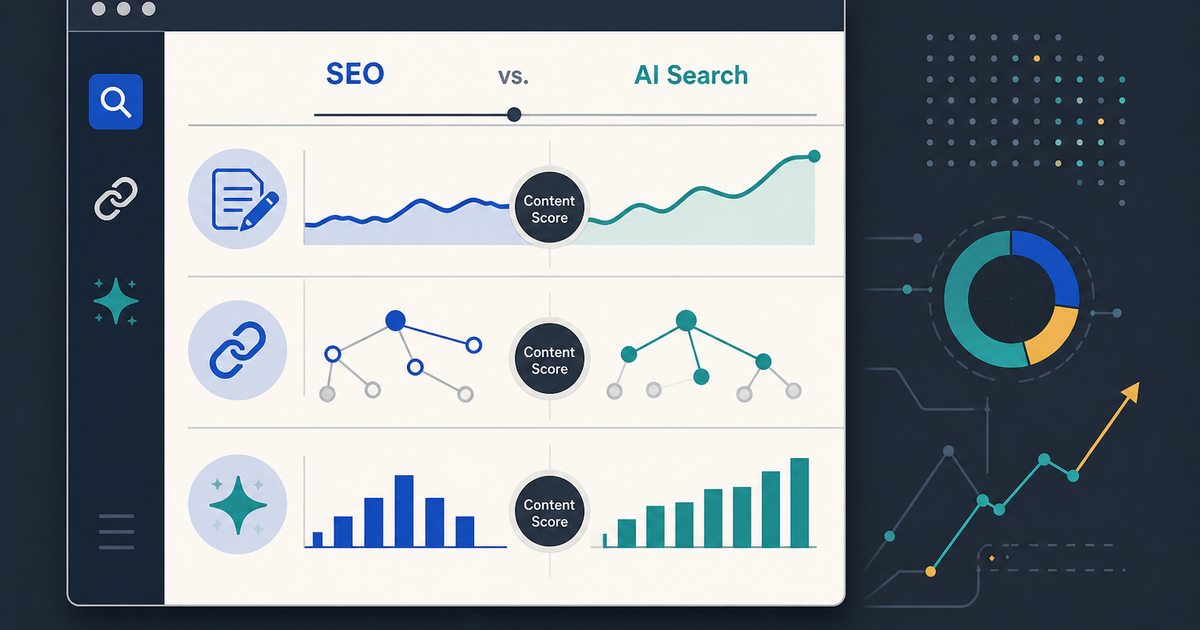
The outcome criteria are straightforward. Look at publishing velocity, internal linking, structured data, content refreshes, and whether the provider can show traffic growth or AI visibility gains without adding a lot of manual overhead. If the provider cannot repeat the process, the model will not compound.
Essel is built around that compounding model, which is why this comparison matters: the product is meant to act like an AI SEO team that keeps the workflow moving instead of stopping at recommendations.
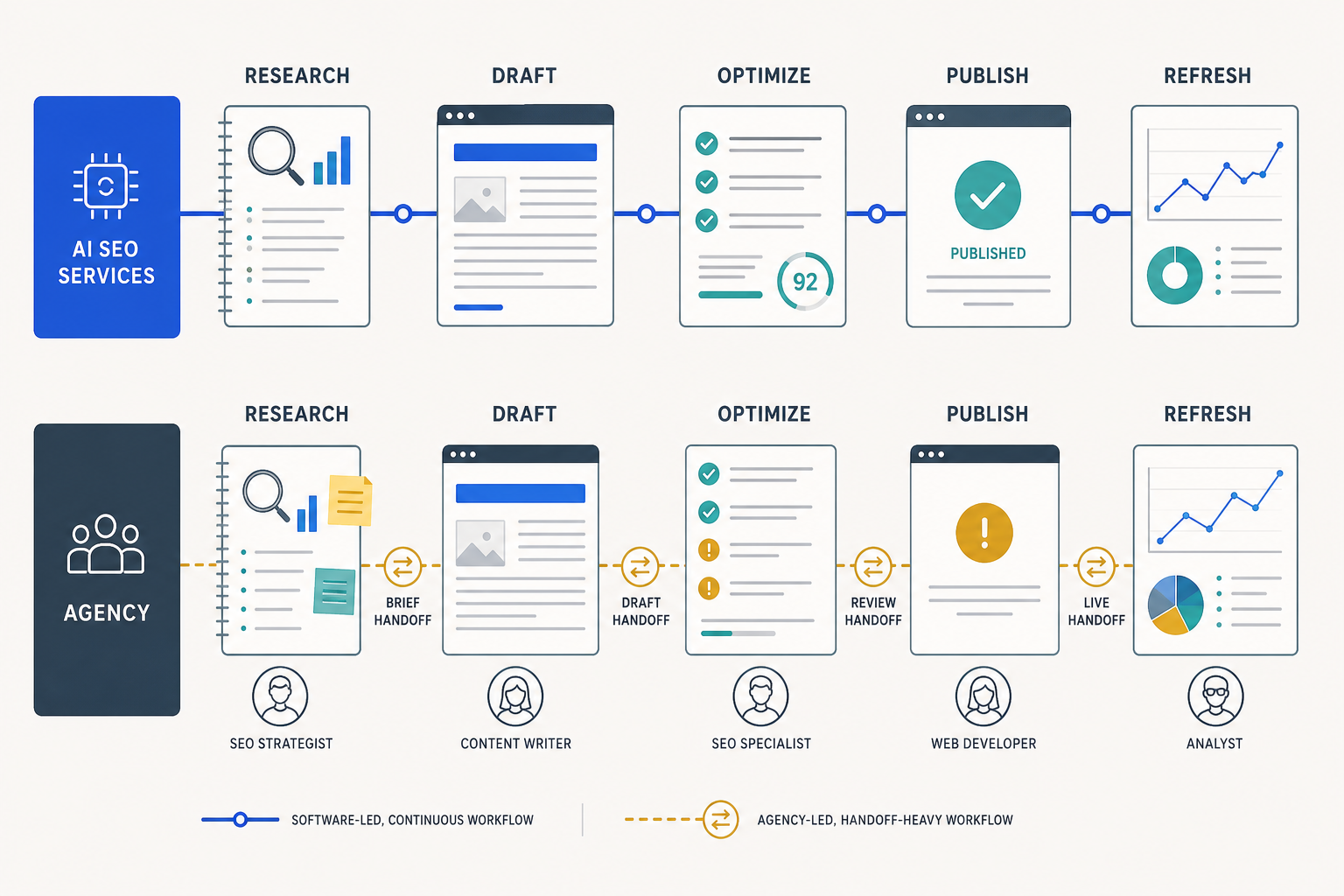
A quick view of where each model handles the content workflow.
What should buyers compare before choosing?
The right choice comes down to whether the provider can deliver the full content loop repeatedly, not whether the homepage sounds modern. A useful comparison starts with workflow depth, visibility coverage, proof, and cost shape. For a practical framework, the AI SEO tools buying checklist is a good companion read.
| Criterion | AI SEO services | AI SEO agency |
|---|---|---|
| Workflow depth | Research, draft, optimize, publish, refresh | Usually mixed manual and AI-supported work |
| Visibility coverage | Google Search, AI Overviews, ChatGPT, Perplexity, AEO, GEO | Often depends on the team and engagement scope |
| Proof signals | Content throughput, traffic growth, visibility movement | Case studies, strategy wins, campaign outcomes |
| Cost structure | Subscription or annual plan | Retainer or project fees |
| Management load | Lower once the workflow is set | Higher, because coordination stays human-led |
| Best fit | Ongoing content cadence and compounding growth | Custom campaigns and strategic complexity |
- Ask whether internal linking, content scoring, and CMS publishing are built in or bolted on.
- Ask what evidence they can show for traffic growth, AI visibility, and publishing consistency.
- Ask who owns the workflow day to day and how much manual review your team will still need.
Cost matters, but not in isolation. A cheaper engagement that requires constant oversight is often more expensive than a subscription that keeps shipping.
Why do AI SEO services win for content-heavy teams?
AI SEO services win on speed, scale, and repeatability because they automate the work that normally gets stuck between strategy and publishing. That is the difference between a plan and a system. When the workflow is built properly, the team can move from topic research to live pages without rebuilding the process every week.
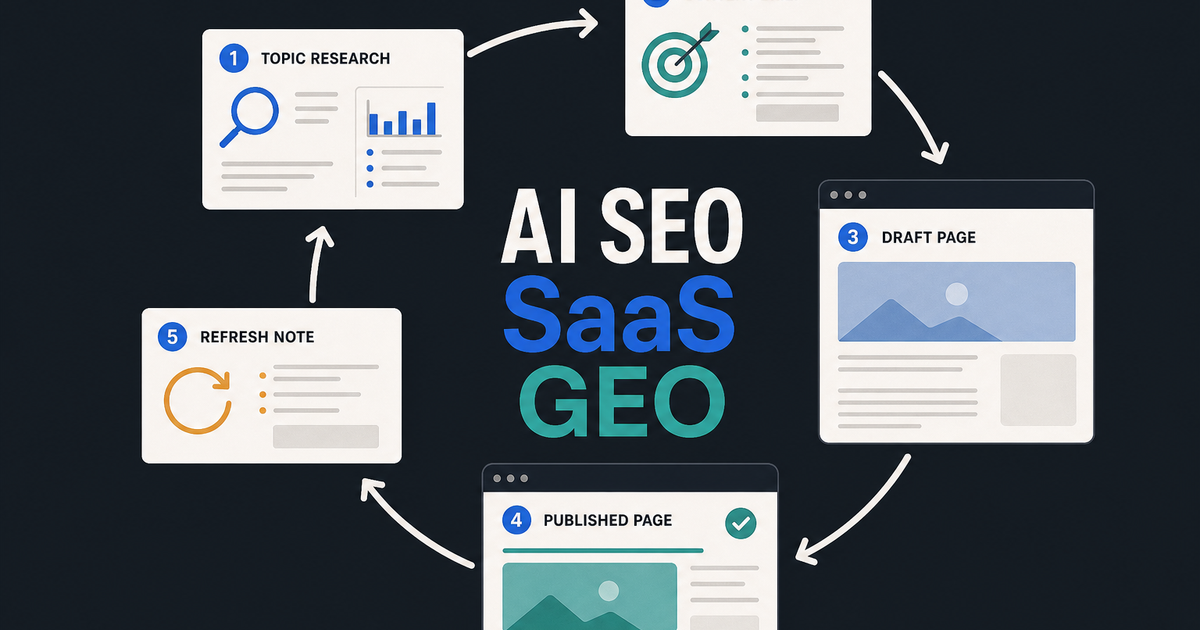
This is especially strong for SaaS teams. They usually need a steady content cadence, topical gap coverage, and internal linking that connects pages into a real topical map. They also need refreshes, because content that ranks once can drift quickly as competitors publish, update, and expand.
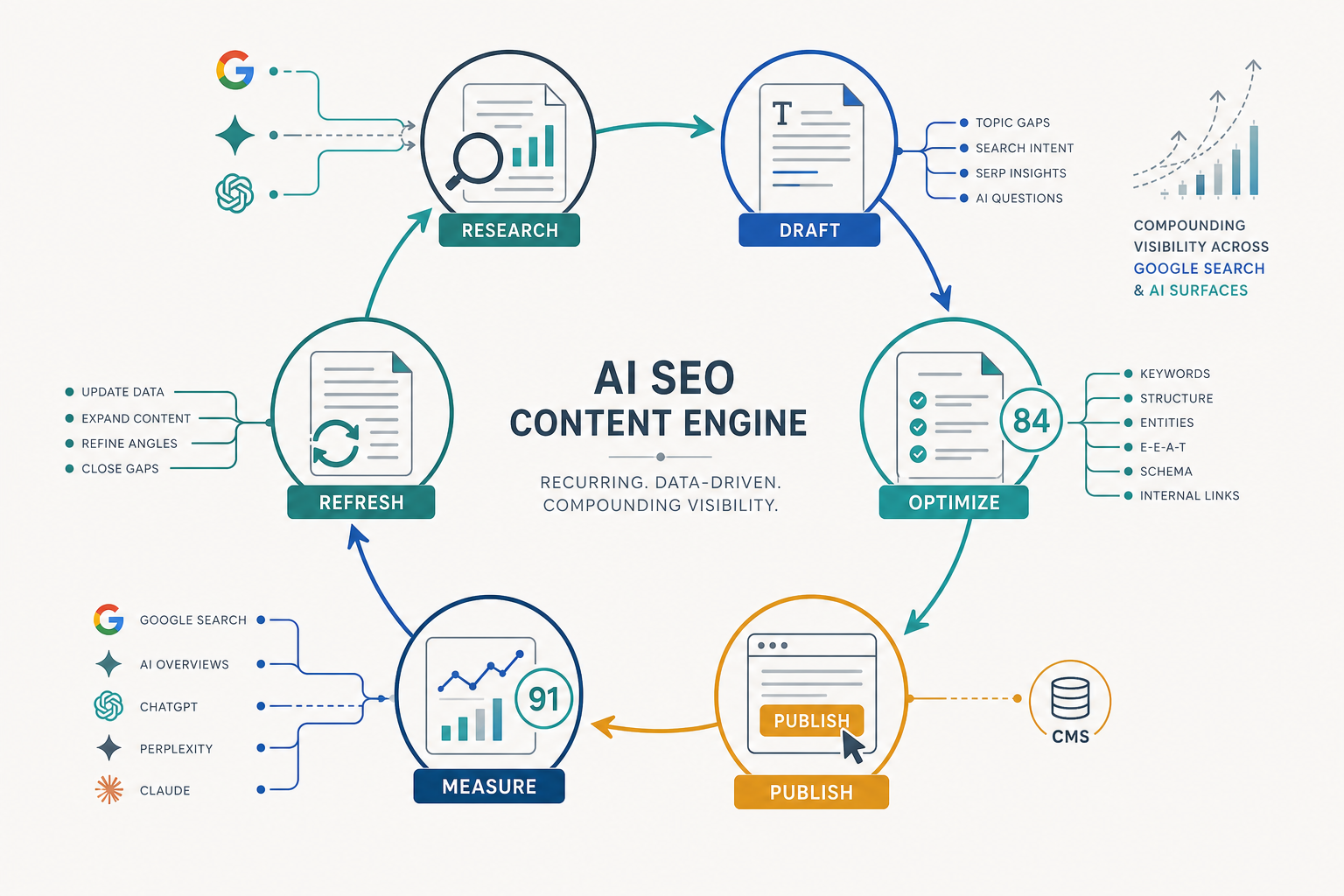
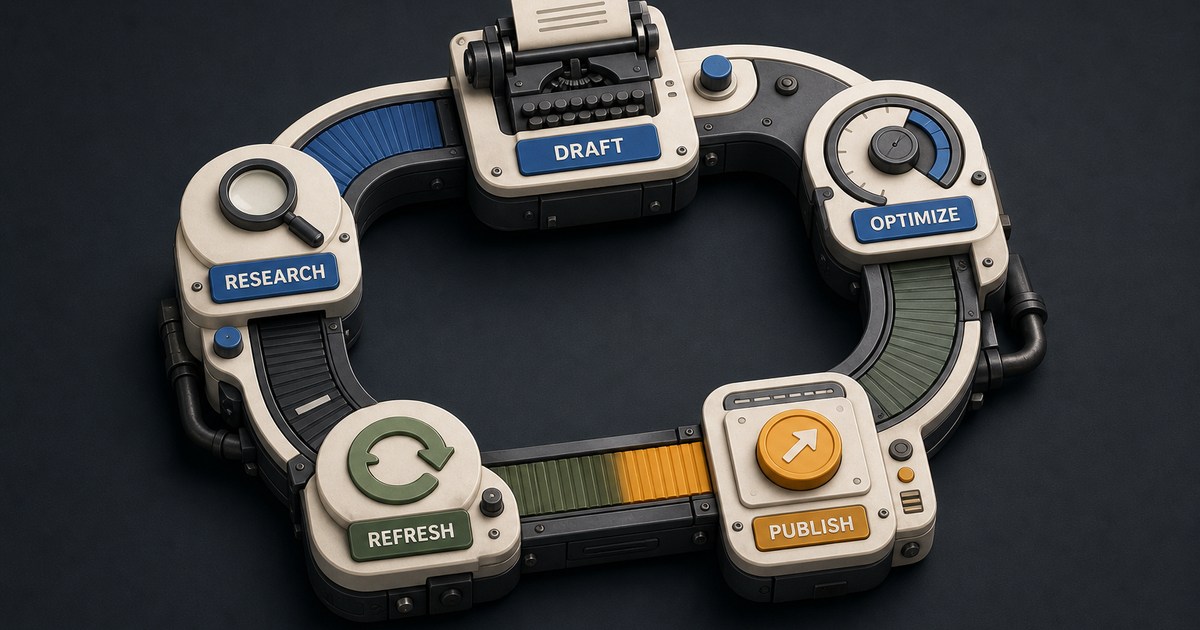
The loop illustrates why repeatable execution compounds over time.
The visibility advantage now extends beyond Google Search. Strong AI SEO services should support AEO and GEO, which matter for AI Overviews, ChatGPT, and Perplexity visibility. If you want the terminology cleaned up, this explainer on SEO for AI naming is the easiest way to separate AEO from GEO without adding jargon.
E-E-A-T still matters here. AI can accelerate research and drafting, but the content still needs source quality, human review, and a clear point of view. The best systems do not replace judgment, they scale it.
A workflow-first model also gives you more leverage over content scoring and optimization. Instead of asking a team to remember every on-page detail, the system can apply the same standards across pages, then keep improving them over time.
When do AI SEO agencies still make sense?
AI SEO agencies still make sense when the problem is too bespoke for a repeatable content engine. That usually includes complex migrations, large stakeholder groups, unusual technical constraints, or campaigns that require a lot of cross-functional coordination.
In those cases, the buyer is not just paying for execution. They are paying for judgment, account management, and hands-on planning. That can be valuable when the scope is messy or when the internal team needs a partner to drive consensus.
The trade-off is throughput. Agencies often depend on a mix of strategists, writers, editors, and operators, which can improve customization but slow delivery. Even when they use AI internally, the buyer is still buying the service layer, not an autonomous content engine.
That is why the phrase best AI SEO agency is less useful than most buyers think. Best for what? If the goal is custom strategy, the agency may be right. If the goal is sustained output, the model may be too manual.
Side-by-side: delivery, speed, visibility, and cost
The practical difference is not philosophical, it is operational. AI SEO services usually ship more consistently, while agencies usually offer more bespoke oversight. The buyer should choose the model that matches the work, not the marketing.
| Decision area | AI SEO services | AI SEO agency |
|---|---|---|
| Automation | High, with repeatable workflow steps | Variable, often dependent on people |
| Content cadence | Easier to maintain monthly or weekly output | Can be strong, but usually slower to scale |
| Optimization depth | Built into the system | Depends on the team and package |
| Publishing support | Often included through CMS workflows | May require separate coordination |
| Refresh speed | Fast, because the workflow already exists | Slower, because revisions run through people |
| Reporting | Usually tied to content and visibility metrics | Often more presentation-led |
| Cost model | Subscription or annual pricing | Retainer or project pricing |
This is also where ai seo packages matter. Packages that include research, optimization, publishing, and refreshes are much closer to a working engine than packages that sell a few deliverables and a monthly call. Buyers should be suspicious of any model that cannot explain how content keeps improving after launch.
For teams comparing workflow automation options, the key question is simple: does the system remove friction, or just create faster drafts?
Which model delivers for each use case?
AI SEO services usually deliver better for SaaS teams, founders, and content-led businesses that need a steady publishing cadence and compounding organic traffic. Agencies fit the edge cases where the work is highly custom, politically complex, or unusually technical.
- Choose AI SEO services if you need recurring content production, topical gap coverage, internal linking, and continuous optimization.
- Choose AI SEO services if your team wants to scale output without adding a full in-house SEO stack.
- Choose an AI SEO agency if you have a migration, a rebrand, or a one-off strategic initiative that needs close coordination.
- Choose an AI SEO agency if your internal team needs a short-term expert partner rather than a permanent workflow.
- Use free AI SEO tools only to test basics before buying the full model. They are useful, but they rarely replace sustained delivery. The free tools workflow limit explains where that ceiling usually appears.
- Start with Essel tools if you want to test a few basics before committing to a full service model: Free SEO & Content Tools.
What proof should buyers ask for before they buy?
The safest way to evaluate ai seo companies or agencies is to ask for evidence that shows repeatable delivery, not just isolated wins. A provider should be able to show traffic growth, ranking movement, AI search visibility, and a workflow that keeps improving content after publication.
- Ask for case studies with before-and-after organic traffic.
- Ask for examples of content that moved in Google Search and, where relevant, in AI Overviews.
- Ask how the workflow addresses AEO, GEO, ChatGPT, and Perplexity.
- Ask whether structured data, internal linking, and refreshes are built in.
- Ask whether the system can publish to your CMS without manual bottlenecks.
- Ask how they measure content scoring and what happens when a page underperforms.
Example: If two providers both promise 20 articles a month, the better one is the one that can show how those articles are optimized, published, linked, and refreshed over time.
That last point is where free ai seo tools usually stop short. They can help with ideas or one-off tasks, but they rarely replace a complete operating loop. Buyers who want sustained output need more than isolated utilities.
The practical recommendation for most teams
For most SaaS and content-led teams, ai seo services deliver better compounding results than a traditional agency because they automate the work that actually drives recurring growth. If the goal is an engine, not a project, choose the model that keeps research, drafting, optimization, publishing, and refreshes moving.
An agency still belongs in the conversation when the scope is unusual: enterprise governance, complex migrations, heavy stakeholder management, or custom strategy that cannot be standardized. That is a valid use case. It is just not the default winner for ongoing search growth.
Modern search visibility now spans Google Search, AI Overviews, ChatGPT, Perplexity, AEO, and GEO. If your provider is only thinking about one channel, the strategy is already behind.
Essel sits in the middle of this decision by design. It is the option for teams that want autonomous content execution with SEO discipline, not a spreadsheet full of tasks.
If you are comparing providers, start with the workflow, not the pitch. Then check proof, publishing, refreshes, and how much of the stack you still have to manage.
Frequently asked questions
What is the difference between AI SEO services and an AI SEO agency?
AI SEO services are usually software-led and workflow-driven, while an AI SEO agency is usually human-led and service-driven. In practice, services emphasize repeatability, publishing cadence, and automation, while agencies emphasize strategy, coordination, and custom execution.
Are AI SEO services better for SaaS companies?
Yes, most SaaS companies get more leverage from AI SEO services because they need ongoing content cadence, topical gap coverage, and fast optimization. SaaS growth usually depends on compounding pages, not occasional campaign bursts.
Do AI SEO services help with AEO and GEO?
Yes, the better ones do. A strong AI SEO service should support AEO and GEO by optimizing for Google Search, AI Overviews, ChatGPT, and Perplexity, not just classic blue-link rankings.
How do I know if an AI SEO provider actually delivers results?
Ask for proof of traffic growth, ranking movement, AI visibility, CMS publishing, structured data, internal linking, and refresh performance. If they cannot show a repeatable workflow, they are selling output, not delivery.
Last updated: 2026-07-06