Best AI SEO Tools for Lean Teams in 2026
As of July 2026, the best AI SEO tools for lean teams are the ones that collapse research, drafting, optimization, publishing, and refreshes into one workflow. That matters because small teams do not win by adding more tabs. They win by removing handoffs, tightening content cadence, and shipping pages that stay aligned with Google, AI Overviews, ChatGPT, and Perplexity.
Essel does that by acting as an autonomous AI SEO team, while the other tools in this roundup each cover different parts of the stack.
Key takeaways
- Lean teams should judge AI SEO tools by workflow coverage, not by how good the draft output looks in isolation.
- The strongest setup reduces manual work across research, optimization, publishing, and refreshes.
- If you already have writers and editors, a focused optimizer can be enough.
- If you need one small team to run the whole content loop, an autonomous platform is the better fit.
- AI search visibility now matters alongside Google rankings, so GEO and AEO belong in the buying criteria.
What lean teams should optimize for in AI SEO tools
The best AI SEO tools for lean teams are the ones that replace repeatable work, not just speed up writing. A tool earns its place when it shortens the path from keyword to live page, keeps content scoring tight, and helps the team revisit pages without rebuilding the process every month. For a simple buying lens, start with an internal checklist like what to look for before you buy.
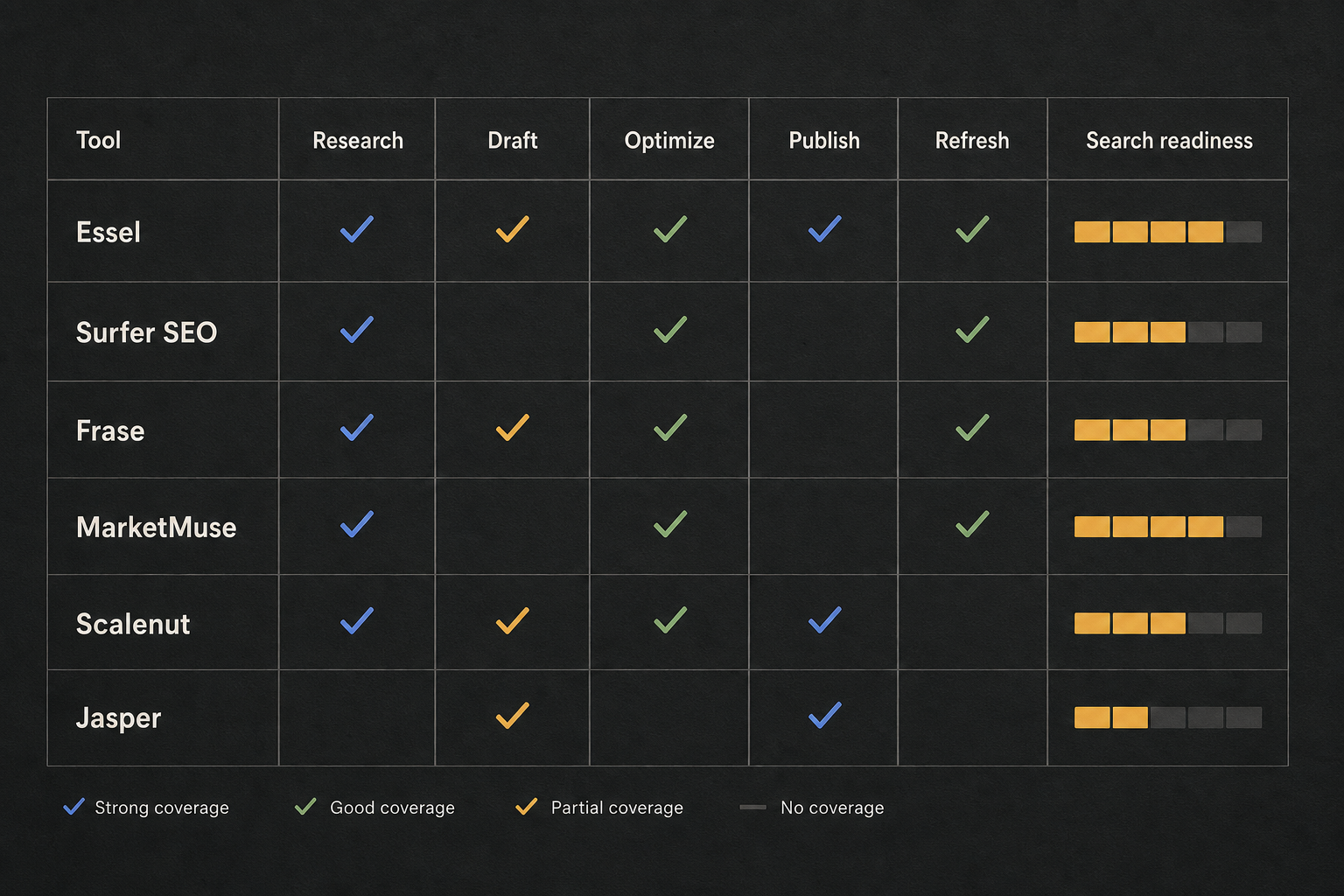
Lean teams should compare tools by how much of the workflow they replace.
| Criterion | What good looks like | Why it matters for lean teams |
|---|---|---|
| Research depth | Fast intent mapping, SERP analysis, topical gaps | Fewer manual hours before drafting |
| Drafting help | Briefs, outlines, or first drafts that are usable | Less time spent starting from zero |
| Optimization | On-page recommendations, content scoring, internal linking | Better odds of ranking without extra tools |
| Publishing | CMS handoff or direct publishing | Fewer ops bottlenecks |
| Refreshes | Simple update workflows for old pages | Keeps traffic compounding |
| AI search readiness | GEO, AEO, and AI Overviews support | Helps visibility beyond classic blue links |
| Cost efficiency | Subscription matches team size and cadence | Prevents seo marketing tools sprawl |
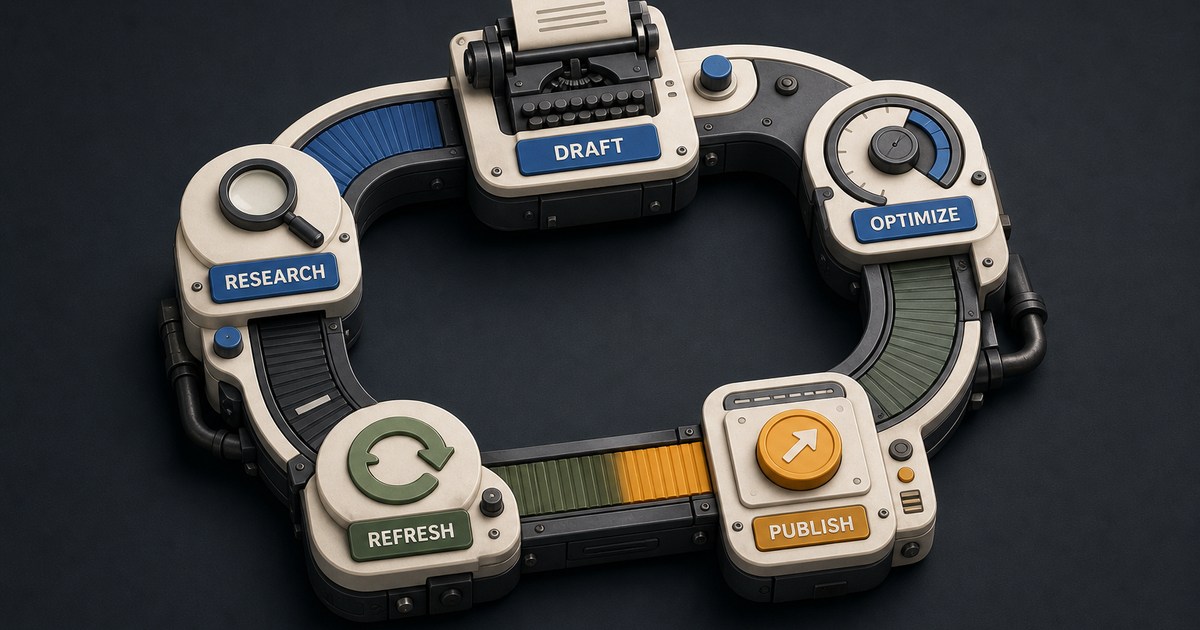
For SaaS and content-led teams, the real question is not whether a platform can generate text. It is whether the platform can cover the full loop with minimal supervision. That loop includes research, drafting, on-page optimization, internal linking, structured data, publishing, and refreshes. If a tool only helps with one slice, you still need people or extra software to finish the job.
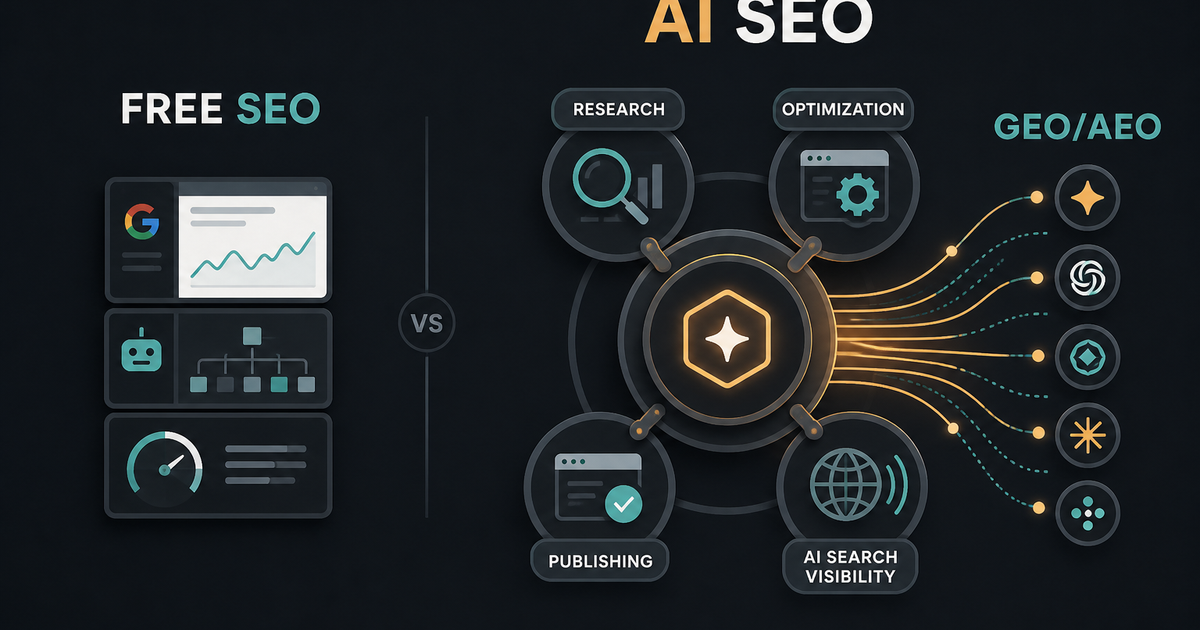
Modern search also changes the filter. Tools that ignore GEO and AEO leave teams blind to how content appears in AI-driven results. If you need the category framing first, this overview of AI SEO and this guide to GEO and AEO are useful context.
Best AI SEO tools in 2026: side-by-side comparison
The best AI SEO tools split into three camps: autonomous platforms, optimization-first tools, and planning-heavy platforms. For lean teams, the right pick depends on whether you need output, guidance, or strategy. If you want the broader market view before narrowing down, Essel’s alternatives page is a quick shortlist starting point.
| Tool | Best for | Lean-team fit | Strength | Trade-off |
|---|---|---|---|---|
| Essel | Autonomous SEO content ops | Very high | Research, drafting, optimization, publishing, refreshes | Less useful if you only want one-off optimization |
| Surfer SEO | On-page optimization | High for writer-led teams | Content scoring and page-level tuning | Does not fully run the content loop |
| Jasper | AI writing workflows | Medium | Fast drafting and marketing copy | SEO depth is not the main value |
| Frase | Research and briefs | High for editorial teams | Intent research and brief generation | More manual work after the brief |
| MarketMuse | Topic strategy | High for planning teams | Topical gaps and content prioritization | Less production automation |
| Scalenut | AI-assisted production | Medium to high | Drafting plus SEO support | Editing load can still be significant |
Essel is the closest fit when a lean team wants one system to do the work of several. Surfer SEO is strongest when writers already exist and the main gap is optimization. Jasper is better when the team needs drafting support first. Frase and MarketMuse sit earlier in the funnel, helping with research and strategy rather than full execution. Scalenut lands in the middle, with more production help than a pure planner but not as much end-to-end automation as an autonomous engine.
The practical trade-off is simple: more strategy depth usually means less workflow coverage, and more workflow coverage usually means less manual control. Lean teams should choose based on where their hours disappear today. If the bottleneck is briefs, pick a research-heavy tool. If the bottleneck is page quality, pick an optimizer. If the bottleneck is the whole content machine, pick the platform that can run it.
Essel: best for autonomous SEO content ops
Essel is the strongest fit when a small team wants one AI system to run the content loop from research to refresh. It handles research, drafting, optimization, publishing, and updates, which removes the need to stitch together separate tools for each stage. That matters for teams that want higher cadence without hiring a full SEO/content bench.
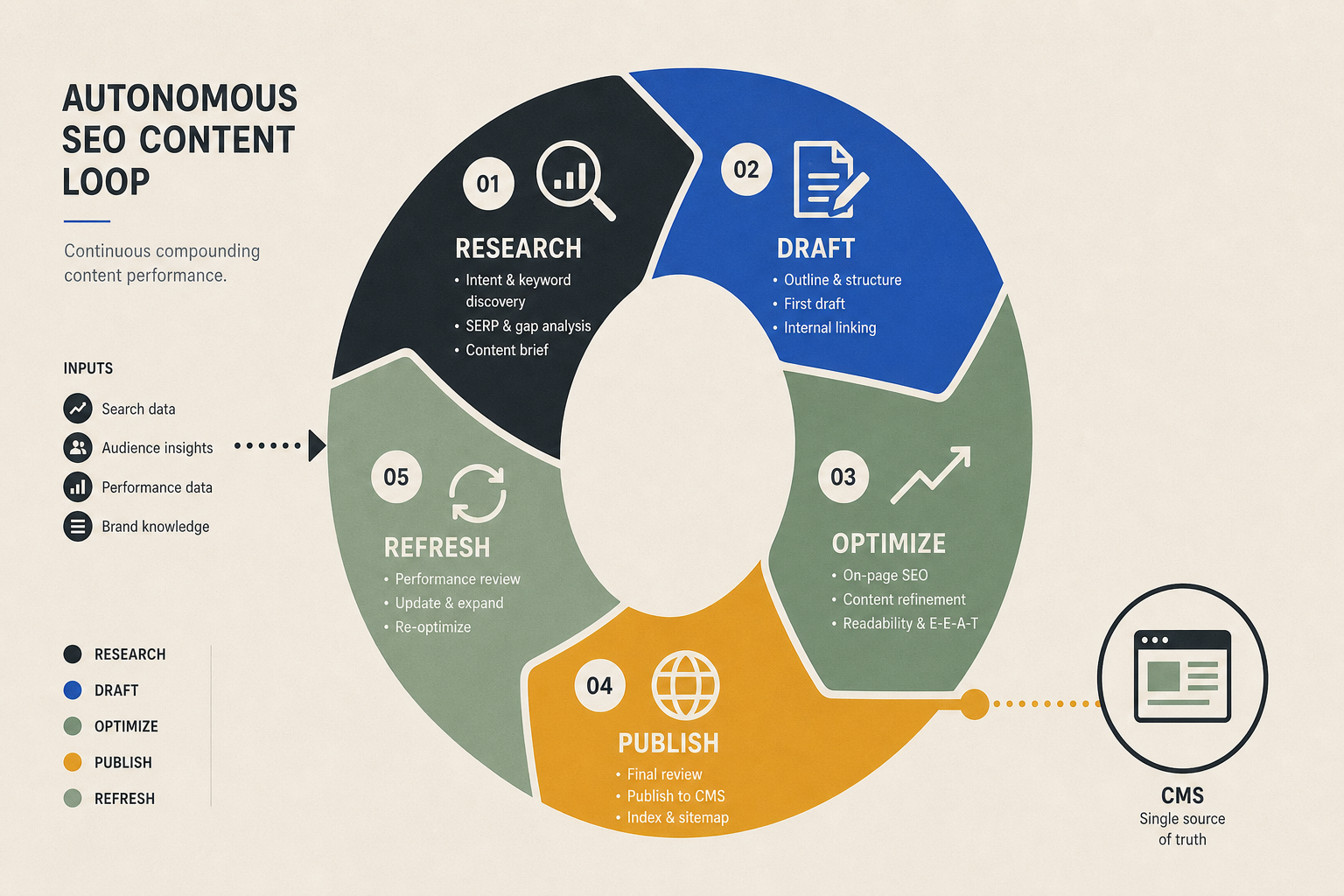
Essel is positioned as the end-to-end option for autonomous content ops.
The core advantage is operational. Lean teams do not usually fail because they lack ideas. They fail because the work gets fragmented across briefs, writers, editors, optimizers, CMS steps, and follow-up refreshes. Essel compresses that process into a single path, so the output keeps moving even when the team is small. That makes it a strong fit for SaaS blogs, content-led businesses, and operators who care about compounding traffic rather than one-off publishes.
It also maps well to modern search visibility. The product is built for Google, ChatGPT, Perplexity, and AI Overviews, so the optimization layer is not limited to classic keyword targeting. For teams that care about GEO, E-E-A-T, internal linking, and structured data, that broader view is the point. The platform is not just helping content exist. It is helping it stay visible across the surfaces buyers actually use.
If you are comparing autonomous content workflows, the natural next step is Essel’s Surfer SEO alternative page. That comparison makes the trade-off obvious: optimization-only versus full content ops.
Surfer SEO: best for on-page optimization workflows
Surfer SEO is the better choice when the team already has writers and needs stronger on-page guidance. It shines at content scoring, SERP-informed recommendations, and page-level optimization, which makes it useful for teams that draft elsewhere and want a sharper edit before publishing. For many lean teams, that is enough to improve output without rebuilding the whole stack.
The limitation is scope. Surfer SEO helps you optimize content well, but it does not fully replace the research, publishing, and refresh layers a lean team still has to manage. If your process already includes a CMS workflow, editors, and a repeatable refresh cadence, that may be fine. If not, the tool improves one part of the engine while the rest still needs manual coordination.
That is why it remains a strong benchmark in any comparison of ai seo tools. It is also why teams evaluating alternatives should compare it directly against a system that can run the whole loop. If that is your lens, the Surfer SEO alternative page gives a useful side-by-side frame.
Frase: best for research and content briefs
Frase is strongest when the team needs to move quickly from search intent to a usable brief. It helps turn SERP analysis and topic research into something writers can work from immediately, which is valuable for small editorial teams that do not want to spend half a day assembling outlines by hand. That makes it a practical fit for early-stage content operations.
For lean teams, the appeal is speed at the top of the workflow. Frase reduces the blank-page problem and gets you to a draftable structure faster. The trade-off is that more of the later workflow still sits outside the product. You can use it to accelerate the brief, but you still need a separate system or a manual process for optimization, publishing, and refreshes.
That is why Frase is often a better fit for teams that want a lighter content-ops stack than a full autonomous engine. If you are shortlisting vendors, the Frase alternative page is the natural follow-up once you decide how much of the loop you want automated.
MarketMuse: best for topical planning and content strategy
MarketMuse is the strongest choice when the team needs to decide what to write before it worries about how to publish it. It helps identify topical gaps, prioritise opportunities, and plan coverage across a content portfolio, which makes it useful for teams with a strategy problem rather than a production problem. That kind of guidance is valuable when a site has grown unevenly and needs structure.
The platform is especially useful for portfolio-level planning. Instead of focusing only on a single article, it helps teams think about coverage across clusters, competitors, and authority-building opportunities. That makes it useful for E-E-A-T-led planning, where the goal is not just to rank one page but to build a stronger topical footprint over time.
The trade-off is straightforward. MarketMuse gives more planning leverage than publishing leverage. Lean teams that already have strong editorial ops may love that. Teams that need research, drafting, and CMS execution in one place may find it too front-loaded. In other words, it is a strategy tool first, not an operating system.
Scalenut: best for AI-assisted SEO content production
Scalenut sits between pure writing tools and deeper SEO platforms. It is useful when a lean team wants AI-assisted drafting plus SEO support in the same workflow, without moving all the way into an autonomous content engine. That makes it a reasonable option for teams that want a production boost but still want to keep more of the editorial process in-house.
Its value is in compressing the time from brief to draft. For smaller teams, that can be enough to increase output without adding people. The question to ask is how much manual editing remains after generation, because that determines whether the platform is really saving time or just shifting effort from writing to cleanup.
That is also where it belongs in the broader category of seo ai tools. It is a production-oriented option, not just a generic writing assistant. For teams comparing the field, it is worth judging beside tools that actually improve the whole SEO workflow, not only the first draft.
How to choose the right AI SEO tool for your team size
The right choice depends on how much of the content loop your team has to own. A solo founder, a two-person marketing team, and a larger content operation need different levels of automation. The smaller the team, the more valuable it is to have research, drafting, optimization, publishing, and refreshes in one system.
| Team setup | Best fit | Why |
|---|---|---|
| Solo founder or tiny marketing team | Essel | One platform can cover the whole loop with minimal handoff overhead |
| Writer-led team with editors | Surfer SEO or Frase | They improve drafting and optimization without replacing the whole stack |
| Strategy-heavy content team | MarketMuse | It helps prioritize what to write and where the gaps are |
| Production-focused team | Scalenut | It speeds up drafting with SEO support |
| Brand team with copy needs beyond SEO | Jasper | Useful when marketing writing is the main job |
Before you buy, check four things: CMS publishing, internal linking, structured data, and refresh automation. Those are the features that prevent tool sprawl. They also determine whether your subscription saves time every month or just creates another dashboard.
If you want a broader commercial comparison beyond this shortlist, Essel’s alternatives page is a useful place to continue.
What SEO AI tools are used in lean teams?
Lean teams usually use one tool for research, one for optimization, and one for publishing or automation. The exact mix changes, but the pattern stays the same: reduce repetitive work and keep the content cadence moving. In practice, that often means pairing a planning or brief tool with an optimizer, then using a CMS or workflow layer to get pages live.
That is why AI SEO tools in marketing are most valuable when they support ongoing output, not just one-off generation. A lean team needs repeatability. If every article takes a different manual process, the stack is too heavy. The best systems let a small team move from topical gap to live page to refresh without rebuilding the workflow each time.
For teams that want a single operating layer rather than a collection of point tools, an autonomous platform is usually the cleaner answer. For teams that already have strong editorial and publishing ops, a narrower tool can still be the right call. The right setup is the one that fits the actual headcount.
What SEO AI tools do you use?
Most lean teams use a compact stack: one research tool, one optimizer, and one publishing layer. That could mean Frase for briefs, Surfer SEO for optimization, and a CMS process for publishing, or it could mean one autonomous platform that handles the whole chain. The best choice depends on whether the team wants modular control or fewer moving parts.
Why are SEO AI tools important?
SEO AI tools matter because they reduce manual work and make content cadence sustainable for small teams. They also help teams adapt to AI search visibility, not just Google rankings, which is where GEO and AEO now matter. When the stack is set up well, the team can publish more often, refresh faster, and keep content aligned with search demand.
How do SEO AI tools work in WordPress?
In WordPress, these tools usually sit before or alongside the CMS workflow. The team researches a topic, generates or optimizes the draft, then moves the content into WordPress for final checks and publishing. The cleanest setups keep internal linking, metadata, and refresh tracking close to the CMS so the workflow does not break at handoff.
If the tool can publish directly or sync cleanly with WordPress, the process gets faster. If not, the team still saves time upstream, but the last mile remains manual.