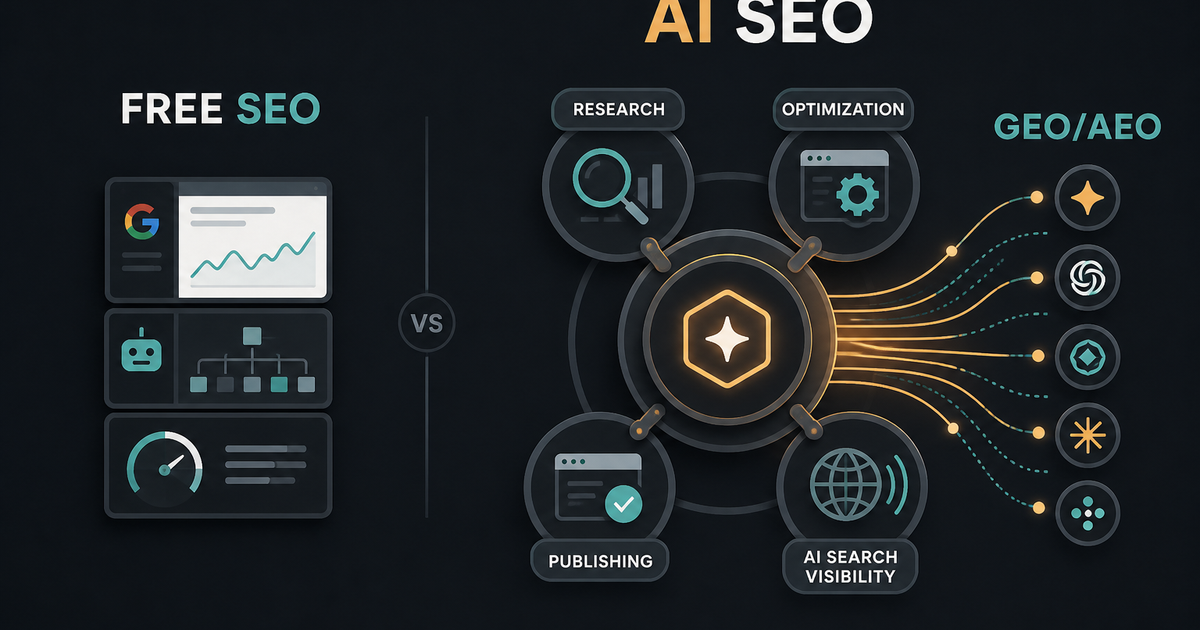
Free AI SEO Tools: Enough Until Workflow Breaks
As of July 2026, free AI SEO tools are enough for audits, quick checks, and low-volume content work, but they stop being enough the moment your team needs repeatable research, internal linking, publishing, and refreshes across Google and AI search. Essel fits that latter case by automating the SEO content loop so teams can move beyond one-off checks without building a full stack by hand.
Key takeaways
- Free tools work well for spot checks, simple audits, and validating a single page or keyword idea.
- Google Search Console is necessary, but it does not replace content operations, linking, or publishing.
- GEO, AEO, ChatGPT, Perplexity, and AI Overviews all raise the bar beyond basic SEO checkers.
- The upgrade point is not about tool count. It is about whether the workflow has become the bottleneck.
- A full platform matters when you need automation across research, drafting, optimization, publishing, and refreshes.
The short answer: when free AI SEO tools are enough
Free AI SEO tools are enough when the job is narrow, the site is small, and the workflow is still manual. If you only need a quick audit, a few keyword ideas, or a one-page content check, free tools can get you to a useful answer fast. They are also fine when you publish occasionally and do not need a system that keeps improving pages after launch.
That means a founder with one blog, a small SaaS site, or a marketer validating an idea can stay free for a while. The catch is that free tools mostly answer questions. They do not run the process.
What free AI SEO tools can realistically cover
Free AI SEO tools usually cover the first layer of SEO work. That layer includes basic audits, keyword suggestions, on-page checks, and quick content analysis. In practice, they are useful for the same early tasks people mean when they search for seo software tools free or a free seo audit tool: catch obvious issues, spot missing tags, and sanity-check a page before you spend more time on it.
They are also a decent way to test [ai seo optimization] ideas before paying for a larger platform. If you want to see whether a page title, heading structure, or content angle is worth pursuing, a free checker can provide a fast signal. For teams that already use Google Search Console, free tools can help turn raw data into a first pass at action items.
Where they help most is diagnosis. They can tell you that a page is thin, a heading is off, or a query has impressions without clicks. They can even support early GEO and AEO experiments by showing whether content is structured clearly enough for modern search surfaces. But they rarely go much further than surfacing the issue.
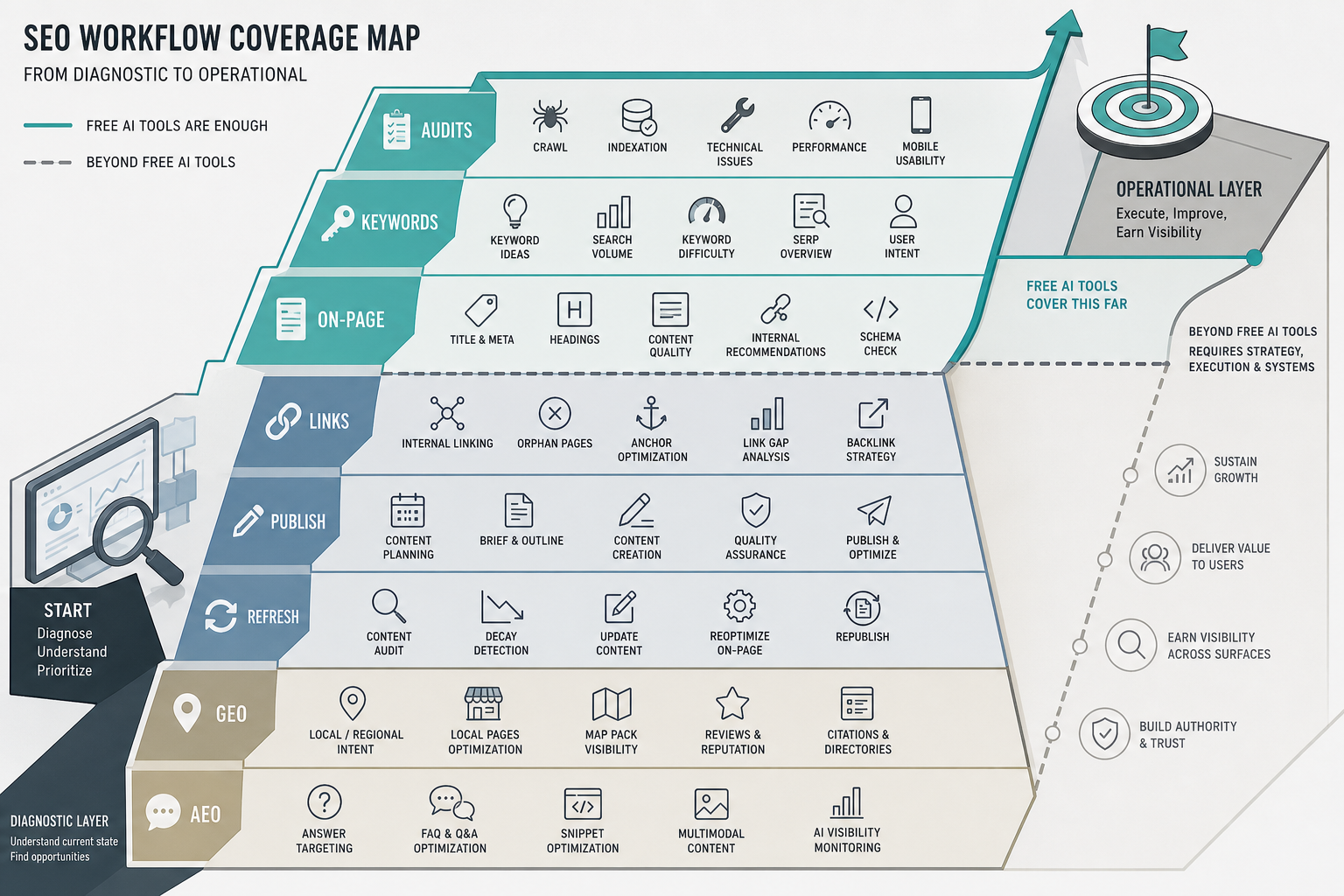
Free tools cover diagnosis first; execution and visibility tracking sit beyond the handoff.
Tip: If a free tool can answer your question in under five minutes, it is probably doing its best work. If the answer requires three more tools and a spreadsheet, you are already near the limit.
Where free AI SEO tools break down
Free AI SEO tools break down when the work stops being a check and starts becoming an operating system. That is the point where the team needs consistent content cadences, internal links, structured data, publishing, and refresh cycles, not just a report. A free tool can flag a problem, but it usually cannot own the next three steps.
That gap matters more as the site grows. A single-page SEO audit is useful, but it does not become a workflow. A checklist can show what is wrong, but it does not assign the fix, write the update, publish the page, and revisit it next month. In other words, the tool may give you insight, but the team still carries the execution load.
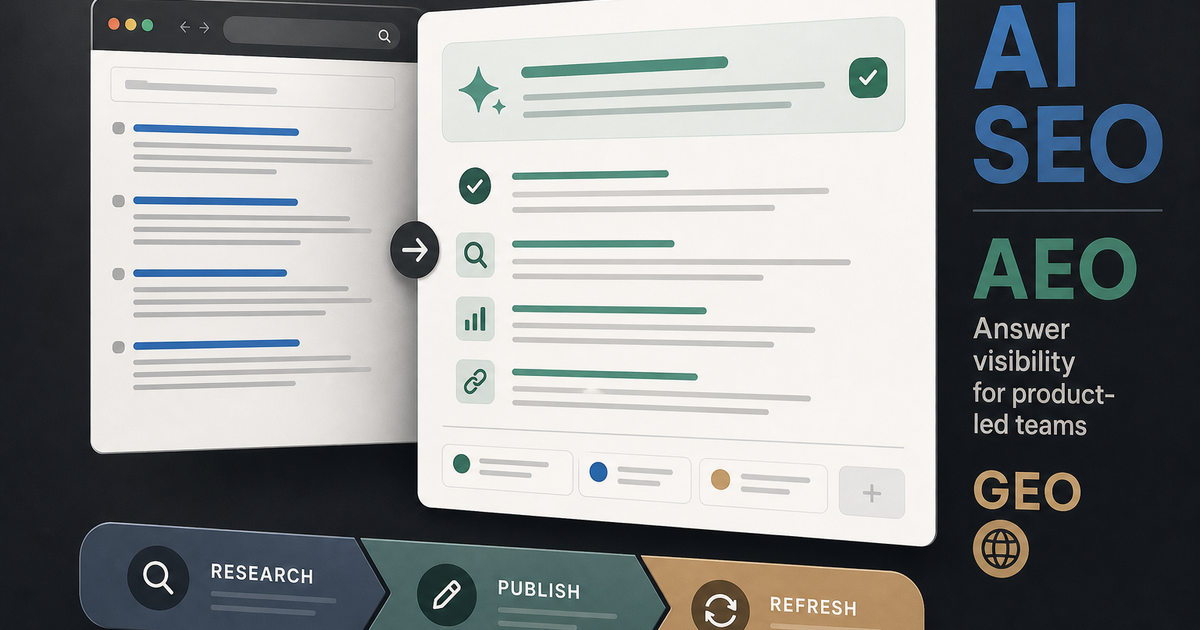
This is also where modern search raises the bar. If your visibility strategy includes ChatGPT, Perplexity, and AI Overviews, you need more than classic ranking checks. You need a system that keeps content current, linked, and structured for both traditional SEO and AI search visibility. If you want the broader context behind that shift, what AI SEO means in practice is a useful companion read.
The failure mode is simple: a free tool is still asking for a human handoff at every step.
The cutoff tests: stay free or move up?
Use a simple cutoff rule: stay free for validation, upgrade when the workflow becomes the bottleneck. If you are unsure, the decision usually shows up in how often the same work has to be repeated by hand. If one person can keep up with the audits, fixes, and drafts, free tools are probably still fine.
If the answer is no, use this checklist:
- [ ] You publish only occasionally and do not need a strict content cadence.
- [ ] You manage a small site with a limited number of pages.
- [ ] You only need quick checks, not ongoing optimization.
- [ ] You can handle internal linking and updates manually.
- [ ] You do not need recurring refreshes across old posts.
- [ ] You are not trying to track AI search visibility as a core channel.
If several of those items fail, free tools are no longer the right centre of gravity. At that point, the next question is not “which free tool is best.” It is “what upgrade criteria should we use?” A practical AI SEO tools buying checklist helps teams make that call without guessing.
Why SaaS teams outgrow free tools faster
SaaS teams outgrow free tools faster because their SEO work is not a one-off task, it is a system. They have more pages, more stakeholders, more launches, and more pressure to tie content to pipeline. That means the team needs How to Do AI SEO for Small SaaS Teams that coordinate research, drafting, optimization, publishing, and refreshes instead of leaving each step in a separate place.
They also need a broader view of search. A SaaS team usually cannot afford to optimize only for classic rankings and ignore GEO, AEO, and AI Overviews. The site has to stay discoverable in Google Search Console, but it also has to show up cleanly in AI-driven answers. Free tools can help expose issues, yet they rarely connect those issues to a content roadmap.
This is why the conversation changes from “what tool can audit a page?” to “what system can keep the whole program moving?” When that happens, free tools stop being the core stack and become a point of support.
What a full platform adds that free tools do not
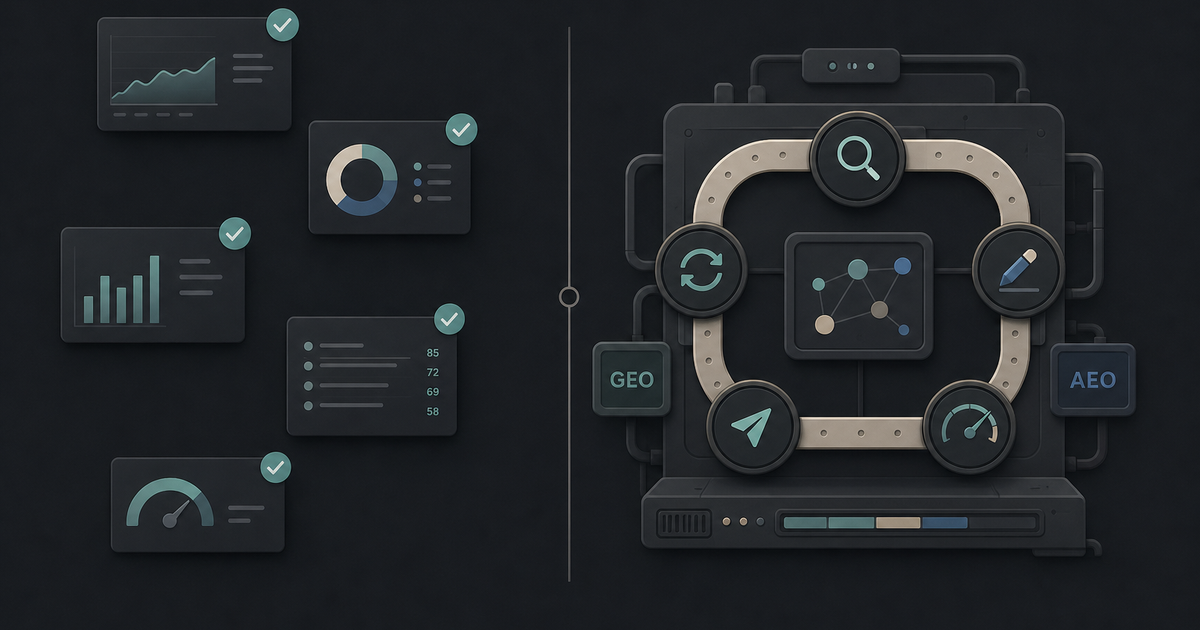
A full platform replaces scattered manual steps with a single content operation. That is the real difference. Instead of doing research in one place, drafting in another, optimization in a third, and publishing somewhere else, the platform can handle the loop end to end. That is the line between a checker and an engine.
| Capability | Free AI SEO tools | Full platform |
|---|---|---|
| Basic audit checks | Yes | Yes |
| Keyword and topic research | Limited | Continuous |
| Content drafting and optimization | Partial | Built into workflow |
| Internal linking | Manual | Suggested or automated |
| Structured data | Usually separate | Integrated |
| Publishing and refreshes | No | Yes |
| GEO and AEO support | Surface-level | Ongoing |
This is where Essel belongs: not as a single-use checker, but as an autonomous SEO content engine that researches, writes, publishes, and improves content on autopilot. If you want the workflow version of that idea, how AI fits into SEO without breaking the process is the right bridge.
For teams specifically comparing the next step after free tools, SEO marketing tools SaaS teams should actually buy are easier to evaluate once the cutoff point is clear.
A practical stack for teams that want to start free
A good free stack is small, boring, and repeatable. Start with the source of truth, add one audit layer, then use one or two lightweight helpers before you ever think about a bigger platform. That keeps the system simple enough to maintain.
- Start with Google Search Console to find pages with impressions, queries, and low click-through rates.
- Run a free SEO scorecard to catch obvious on-page and technical issues.
- Use a free tool stack to validate titles, headings, and basic content structure.
- Check internal linking manually, or use a lightweight anchor text suggester when you need a faster pass.
- Add a simple schema markup generator if you want structured data without building it by hand.
- Upgrade once those steps start taking more time than the content itself.
That stack is enough for validation and early optimisation. It is not enough if you need repeatable publishing, ongoing refreshes, or a content roadmap tied to growth.
Example: A three-page SaaS site can often get by with Search Console, a free audit, and manual edits. A 100-page blog with weekly publishing usually cannot, because the coordination cost overtakes the tool savings.
The decision line for AI SEO in 2026
The decision line is whether your team needs answers or outcomes. Free tools are built for answers. They show what is wrong, what might rank, or where a page needs a quick fix. Paid platforms exist when you need outcomes that repeat across pages and weeks, not just a one-time readout.
Use this rule:
- If you need one-off checks, stay free.
- If you need consistent output, move up.
- If the process depends on humans remembering every next step, the workflow is already breaking.
- If SEO has to support revenue, the tooling has to support execution.
When a team hits that point, the next move is usually to compare an upgrade path against the current stack. Pricing for a platform that covers the full workflow makes more sense than stacking more free tools on top of each other.
Frequently asked questions
Do free AI SEO tools work for GEO and AEO?
Yes, but only at a surface level. Free tools can help you experiment with structure, headings, and page clarity, which matters for GEO and AEO. They do not usually provide ongoing AI search visibility tracking across ChatGPT, Perplexity, and AI Overviews, so they are useful for tests, not for operating a program.
Is Google Search Console enough on its own?
No, because it diagnoses but does not execute. Google Search Console is essential for finding queries, pages, and performance gaps, but it will not write new content, build internal links, publish updates, or manage refreshes. It is the starting signal, not the whole system.
What is the best free AI SEO tool for a small site?
The best free setup is usually a small stack, not one tool. Use Search Console for performance data, a free audit for technical and on-page checks, and one lightweight content helper for structure or scoring. If you want a starting point, the free tools stack is the simplest way to assemble that without overcomplicating the workflow.
When should a SaaS team upgrade from free SEO tools?
Upgrade when publishing, linking, and refreshes become recurring work. That usually happens once the site has multiple content lanes, more than a handful of pages, or a need to track visibility across Google and AI search surfaces. At that stage, the issue is not lack of ideas. It is lack of automation.