SEO Marketing Tools: What an Autonomous Stack Changes
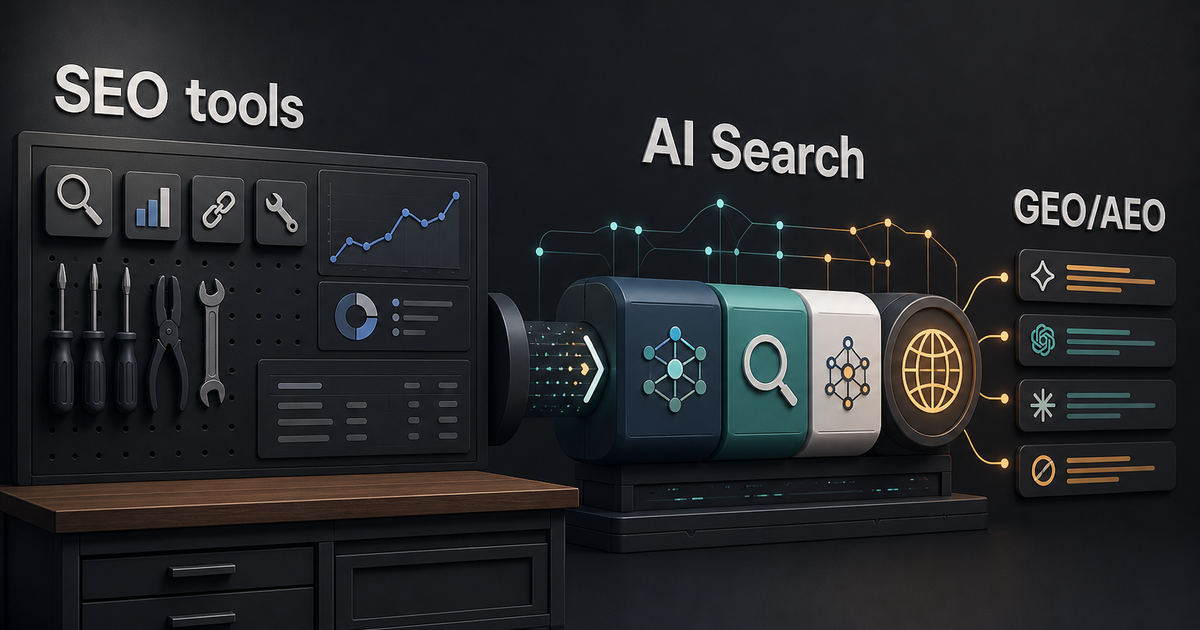
As of July 2026, SaaS teams that still juggle separate seo marketing tools are usually spending more time moving work between tabs than improving content. An autonomous stack changes that by turning research, drafting, optimization, publishing, and refreshes into one loop. Essel is built for that operating model, so the real decision is not which tool looks best on a feature page, but which workflow can run on autopilot.
Key takeaways
- An autonomous stack turns disconnected search optimization tools into a workflow that can plan, execute, score, and refresh content without constant handoffs.
- The best seo marketing tools in 2026 are judged by orchestration depth, not feature count.
- AI search visibility matters alongside Google rankings, so GEO and AEO support now belongs in the buying criteria.
- A purpose-built seo agent can handle repetitive work like keyword clustering, internal linking, and technical audits, while humans keep strategy and approvals.
- Teams usually get more leverage from an ai powered content creation platform than from a bundle of point solutions.
What changes when SEO marketing tools become autonomous?
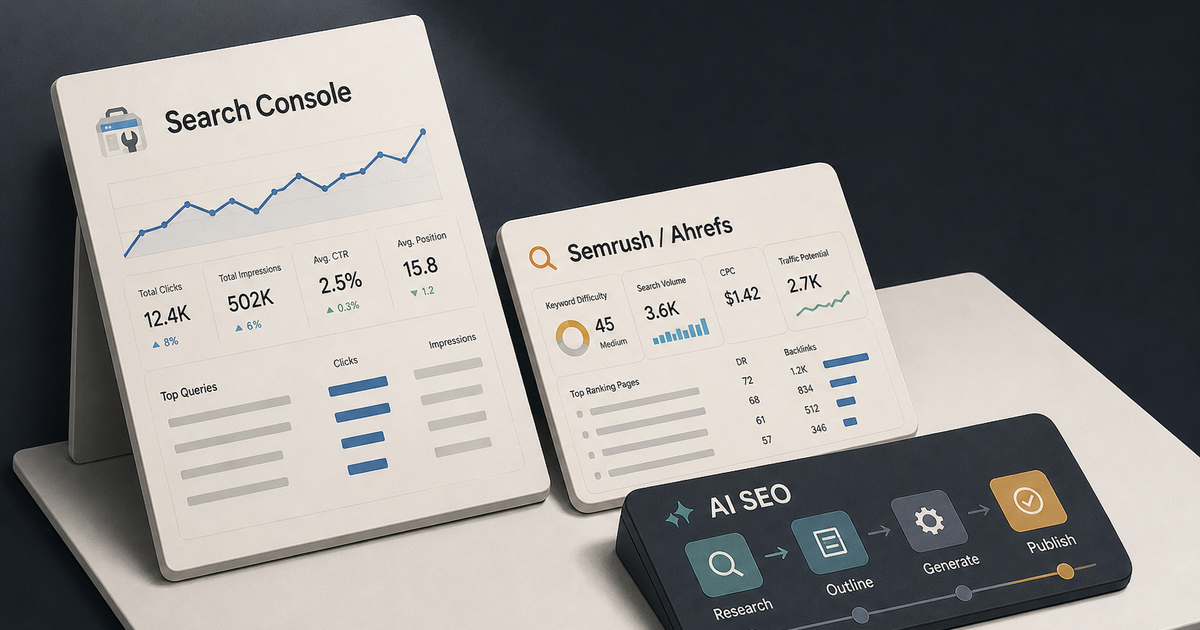
An autonomous stack turns seo marketing tools into a system that does the work, not just a dashboard that reports on it. Instead of bouncing between search engine optimizer tools, seo optimisation tools, and separate briefs, the workflow can move from research to publication with far less manual glue.
The practical change is orchestration. A seo agent can cluster keywords, map topical gaps, suggest internal links, score content against the target page, and hand off a publish-ready draft for CMS publishing. That is a different operating model from the old tool stack, where people had to stitch together search optimization tools, spreadsheets, and editorial checklists.
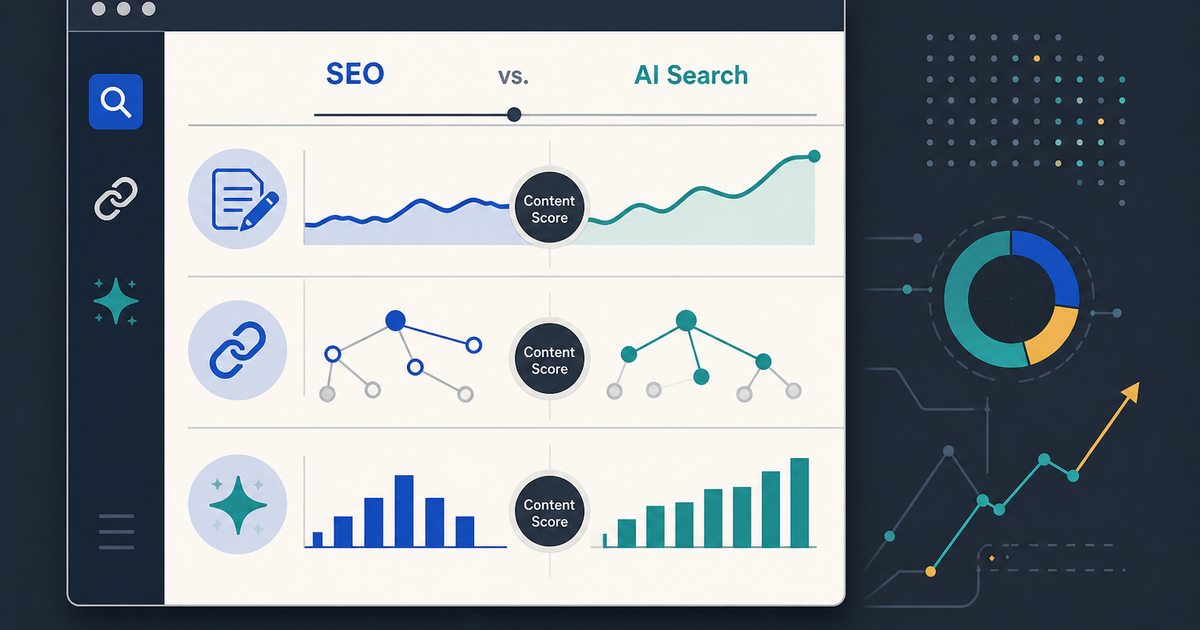
That matters more as AI search becomes a second visibility layer. As of July 2026, teams are not only optimizing for blue links in Google, but also for AI Overviews, ChatGPT, and Perplexity. If the stack does not support GEO and AEO, it is solving yesterday’s problem. For a deeper definition of the category, see what AI SEO covers.
Google’s AI Overview for this query also reflects the shift: it frames AI SEO agents as systems that handle data-heavy, sequential SEO tasks like keyword clustering, internal linking, and technical audits at scale. That workflow logic is the point. In practice, ai for seo is the operating layer, not just a prompt strategy. That means seo optimization software has to do more than draft text: it needs to score pages, manage internal linking, and keep a content cadence alive. That is where an ai powered content creation platform starts to separate itself from generic artificial intelligence for content creation.
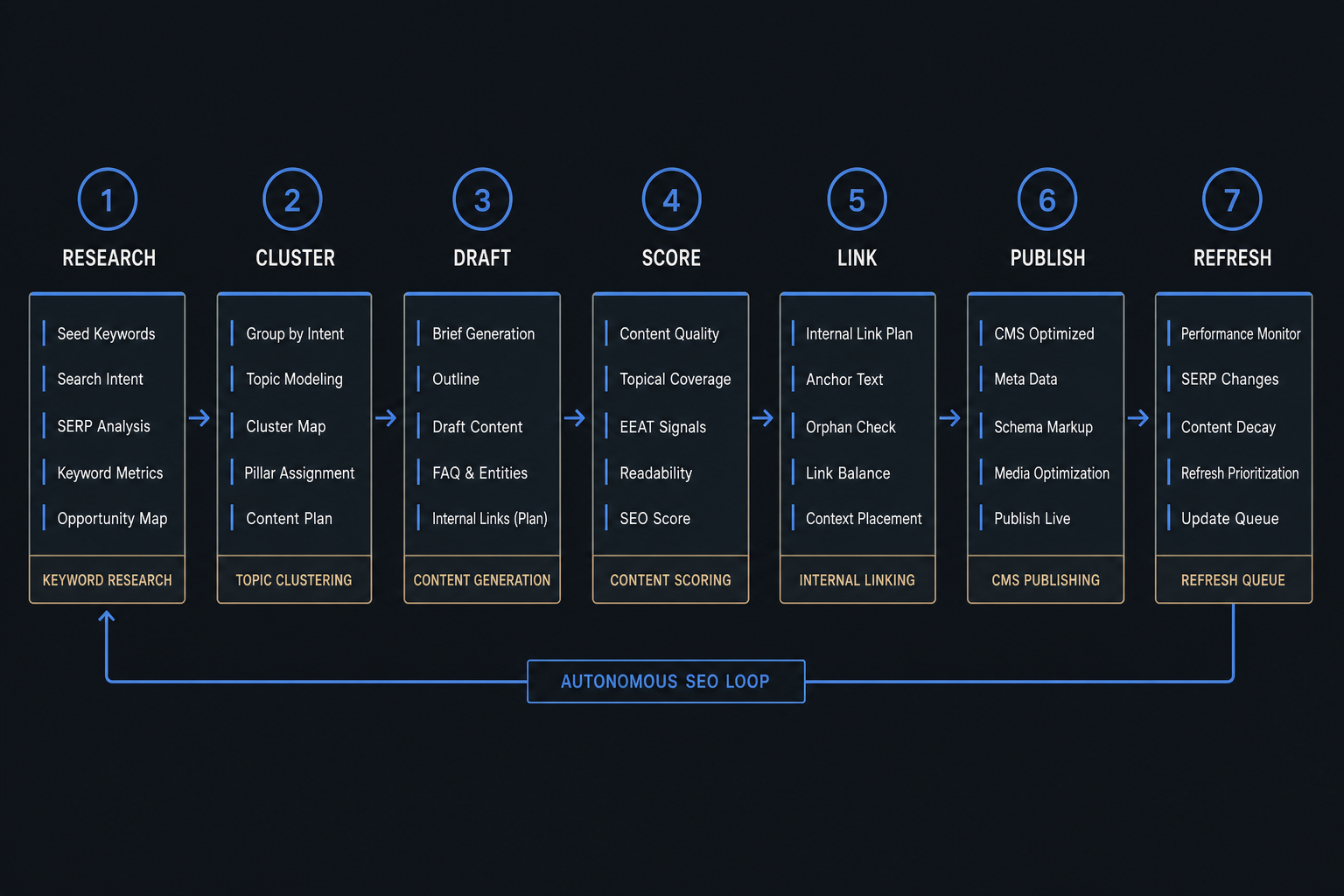
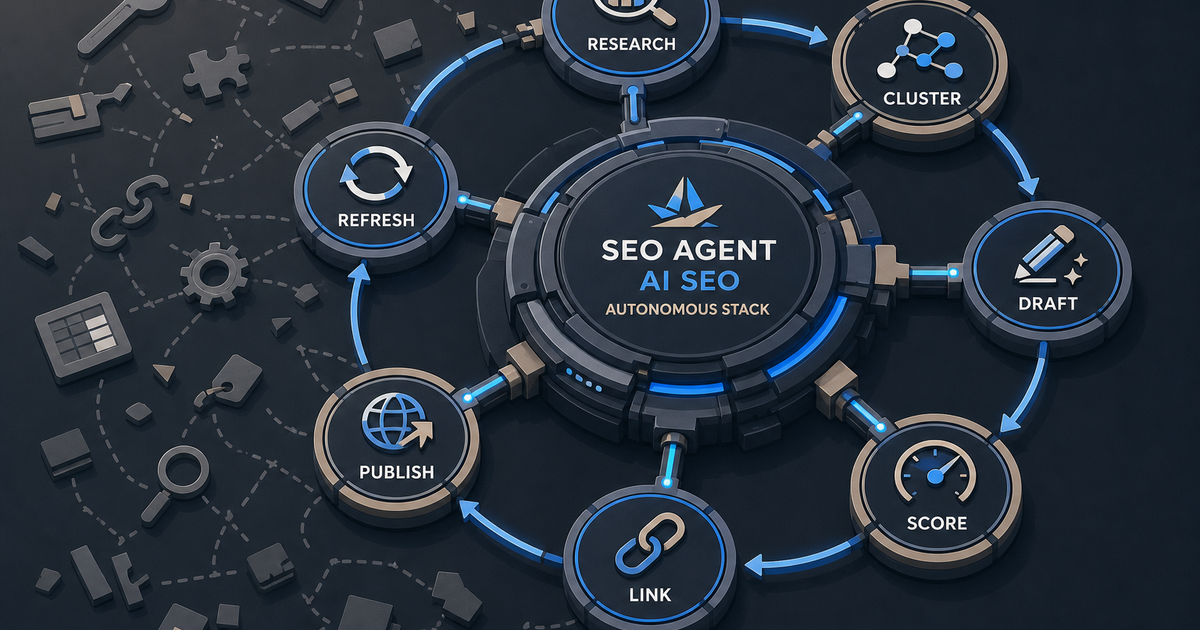
A practical view of how the stack keeps optimization tied to publishing.
The manual stack vs. the autonomous stack
The manual stack depends on people to move work from one tool to the next. The autonomous stack uses AI to coordinate the same jobs end to end, which reduces handoffs and keeps optimization tied to publishing. That difference shows up fastest in content cadence, review cycles, and the number of tools a team has to babysit.
| Criterion | Manual stack | Autonomous stack |
|---|---|---|
| Research | Keyword research lives in one tool, briefs in another | SEO agents cluster topics and build briefs in the same workflow |
| Drafting | Writers move from outline to draft by hand | AI generates first drafts inside the operating loop |
| Optimization | SEO edits happen after the draft is finished | Content scoring and on-page optimization run during creation |
| Internal linking | Links are added later, often inconsistently | Link suggestions are generated as the page is planned |
| Publishing | CMS updates require a separate handoff | CMS publishing can happen from the same stack |
| Refreshes | Old pages are audited occasionally | Refresh queues and re-optimization are continuous |
This is where the commercial value changes. A team using classic seo marketing tools might still get good output, but it spends more time connecting the dots. A team using an autonomous stack spends less time coordinating the work and more time deciding what deserves publication next. That is the difference between buying search optimization tools and buying a workflow.
If your current stack already feels like too many tabs, the comparison is simple: manual systems optimize tasks, autonomous systems optimize throughput. That is why SEO marketing tools SaaS teams should actually buy look less like isolated utilities and more like connected operating layers.
What an autonomous SEO agent actually does
A seo agent can own the repetitive, data-heavy parts of SEO so the team does not have to. It can ingest a keyword set, cluster the terms, prioritize pages, identify missing internal links, flag technical audit issues, and score the content before publishing. The human role shifts from doing every step to setting guardrails, reviewing edge cases, and approving the final output.
That matters because the best SEO work is still sequential. A page usually needs topic selection, clustering, outline generation, draft creation, on-page optimization, linking, and refresh planning. The agent is useful because it keeps that chain intact. It is not magic, and it is not a replacement for strategy, but it does remove the most repetitive coordination work.
A useful way to think about it: the agent is not just another seo a.i label on top of a chat box. It is a workflow layer that can move from signal to action. In an autonomous stack, keyword clustering feeds content planning, internal linking feeds distribution, and technical audits feed remediation priorities.
That also makes the agent useful for AI search visibility. Pages that need better entity coverage, clearer structure, or stronger internal linking can be prioritized for GEO and AEO impact, not just classic ranking lift. If you are mapping this into a broader stack, the orchestration guidance in how to use AI for SEO is the right companion read.
A practical stack for SaaS and content-led teams
A workable autonomous stack has fewer layers than most people expect. The point is not to add more software, but to connect the jobs that already exist so the output keeps moving.
- Start with SEO research that can find topics, gaps, and cluster opportunities.
- Add content scoring so the draft can be judged before it ships.
- Use AI drafting for the first pass, then apply on-page optimization while the draft is still open.
- Generate internal linking suggestions as part of the content plan, not as a post-publish cleanup task.
- Publish directly to the CMS where possible, so the workflow does not break at the last mile.
- Keep refreshes in the same loop so older pages do not drift out of date.
That stack is what separates an ai powered content creation platform from a simple writing helper. It also explains why search engine optimizer tools and seo optimisation tools are being re-evaluated by SaaS teams in 2026. Buyers are not just asking whether the tool can write faster. They are asking whether it can optimize SEO, publish reliably, and sustain a publishing cadence without adding more operators.
There is still a place for standalone search optimization tools when a team only needs one narrow function. But once the team wants content production, internal linking, and ongoing refreshes to move together, the value shifts toward an integrated stack. That is especially true when the team is trying to keep pace with weekly publishing, like the workflow described in ai seo cadence.
What to look for in SEO marketing tools in 2026
The right tool is the one that can move a draft from research to publish and then back into refresh without a human stitching the loop together. That means looking past feature count and checking whether the product can actually run a content system.
| Buying criterion | What good looks like | Why it matters |
|---|---|---|
| Automation depth | It can move from research to publish with minimal handoff | Saves time and keeps work moving |
| Content scoring | It grades drafts before publication | Improves consistency and reduces rework |
| Internal linking | It suggests links from the live content graph | Strengthens topical coverage and crawl paths |
| CMS publishing | It pushes content into the CMS | Removes a common workflow bottleneck |
| AI search support | It accounts for GEO and AEO, not just traditional SEO | Helps content stay visible across Google and AI search |
| Transparency | It shows why it made a recommendation | Builds trust and easier review |
That framework is useful for comparing seo marketing tools, but it is also the fastest way to separate real automation from a feature checklist. If a vendor says it is one of the best seo marketing tools but cannot explain how drafts are scored, linked, and published, you are still buying manual labor disguised as software.
This is also where the buying language gets clearer. People search for seo optimization software and search optimization tools because they want outcomes, not categories. The better question is whether the product behaves like a stack or like another tab. For a fuller checklist, this AI SEO tools buying guide is the closest companion page.
Where autonomous stacks outperform traditional tools
Autonomous stacks win when the work is repeatable and the team needs throughput. They are especially strong when the goal is not a one-off audit, but a system that keeps shipping and improving over time.
- Topical mapping: The stack can identify gaps, cluster terms, and propose pages faster than a manual spreadsheet process.
- Internal linking at scale: The system can suggest relevant links across a growing library instead of relying on ad hoc edits.
- Refresh workflows: Old pages can be queued for updates when rankings slip, facts age out, or AI search visibility changes.
- Content cadence: Teams can publish more consistently without building a bigger SEO ops layer.
- Cross-functional handoffs: Writers, SEO leads, and developers spend less time passing tasks around.
These are the use cases where ai for seo stops being a slogan and becomes an operating advantage. The payoff is not only speed, but continuity. A team that uses an autonomous stack keeps search work moving even when no one is manually shepherding each step.
That is why SaaS teams often prefer an integrated system over a stack of point solutions. If the system can handle research, drafting, optimization, publishing, and refreshes, the team can stay focused on strategy instead of tooling.
What is a SEO agent?
A SEO agent is an AI system that can take a defined SEO task from input to action, instead of only suggesting what to do next. In practice, that means it can cluster keywords, draft briefs, recommend internal links, flag technical audit issues, and push work forward inside a workflow.
The useful distinction is between a helper and an operator. A helper produces ideas. A SEO agent organizes work and executes the next step, usually inside guardrails set by the team. That is why the term matters in commercial SEO: it describes a workflow layer, not just a chat interaction.
The clearest examples are keyword clustering and technical audits. A team can feed in a topic list, have the agent group the terms into page targets, then use the same system to identify pages that need fixes or refreshes. That is materially different from asking a model for a single outline and then doing everything else by hand.
For a brand like Essel, this is the core product promise: the autonomous stack researches, writes, publishes, and improves content on autopilot, so organic traffic compounds across Google and AI search. The homepage shows that operating model in product form.
Can AI agents do SEO?
Yes, AI agents can do meaningful SEO work, especially when the work is repetitive, sequential, and data-heavy. They handle research, clustering, outlines, on-page optimization, internal link suggestions, and refresh prioritization well, as long as the team gives them clear rules and review gates.
They do not remove the need for humans. Strategy, positioning, compliance, and final editorial judgment still belong to the team. The gain comes from moving the mechanical work out of the human loop, not from pretending the machine can own the whole brand.
That is why search optimization tools are evolving into systems that behave more like operators than utilities. They can process a large content backlog faster, but they still need a quality bar. If the workflow is weak, the agent just produces faster noise.
The practical question is not whether AI can do SEO in theory. It is whether the stack can keep the work coordinated, measured, and improved over time. That is the difference between a prompt and a system.
Can ChatGPT do SEO?
ChatGPT can help with SEO tasks, but by itself it does not run the full research-to-publish loop or maintain ongoing optimization. It can draft, brainstorm, and revise, yet it does not automatically manage content scoring, CMS publishing, internal linking, or refresh cycles.
That makes it useful, but incomplete. A chat interface is good for one-off help. An autonomous stack is designed for repeatable output across a publishing program. Teams that need ongoing results usually outgrow ad hoc prompting quickly.
This is where the difference between artificial intelligence for content creation and an ai powered content creation platform becomes obvious. The first helps you generate text. The second helps you operate a content machine. If the job is to optimize SEO at scale, the platform matters more than the prompt.
For teams deciding whether to buy software or keep assembling workflows manually, the commercial side is straightforward. Start with the stack that removes the most coordination, then compare it against the cost of staffing the same process. If you want to see where that lands in practice, pricing is the right next step.
Is an SEO agency worth it?
An SEO agency is worth it when you need strategy, execution, and specialist judgment without building the function in-house. It is usually less compelling when the main problem is operational throughput, because software can automate a large share of the repeatable work.
For SaaS teams, the break-even point often comes down to cadence. If the real bottleneck is producing, optimizing, publishing, and refreshing content every week, an autonomous stack can be the better buy. If the team needs high-touch strategy, migration support, or complex technical oversight, services can still make sense.
That is why this conversation is not really agency versus software. It is manual coordination versus automated coordination. When the software can own the loop, the business usually gets more output per dollar and less dependency on a long services chain.
If the reader is evaluating the category broadly, that is the lens to use when comparing seo marketing tools, agencies, and a fully autonomous stack. The winning setup is the one that compounds content, not the one that creates the most meetings.